Showing posts with label American. Show all posts


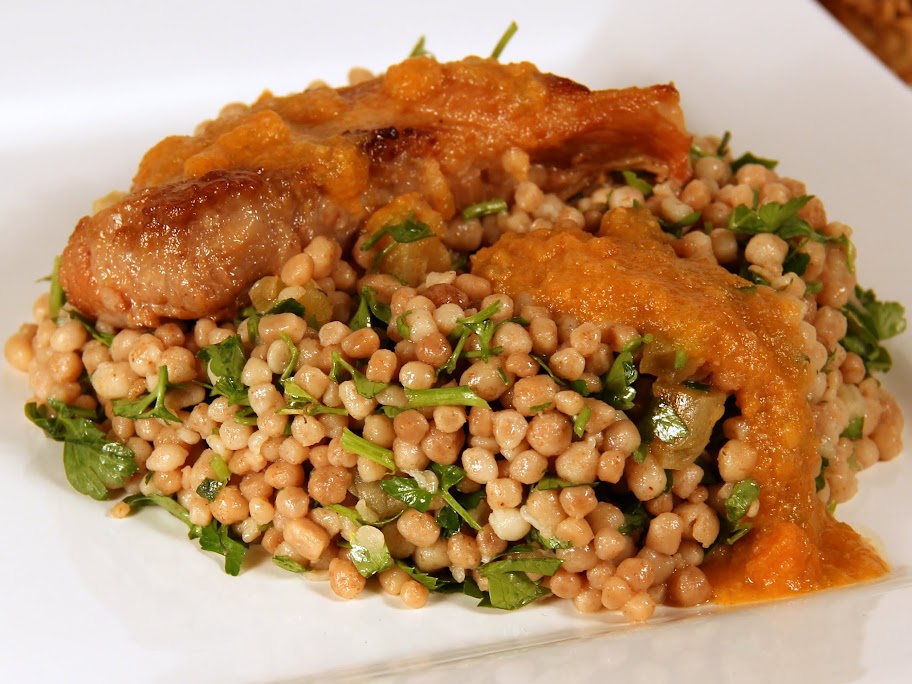
Braised Pork Jowl with Persimmon Gravy
Pork jowl, also known as pork cheek is one of my favorite cuts of pork. When jowl is braised over a long period the meat becomes "melt in your mouth" tender. Pork cheek is both chock full of fat and collagen, so it needs to be cooked low and slow for best results. Think of past experiences with cuts of meat like oxtail, ham hock, and shoulder.

Pork cheek is popular across the world, I have seen it atop a bowl of ramen as Chashu, cooked in a Sichuan style, and cured as the Italian Guanciale. Pork cheek shares many similarities with pork belly, and I have found that it is a wonderful substitution in many cases. One of the best arguments I can make about using pork cheek is the comparable cost per pound. As pork belly has risen in popularity, so has its price. Pork cheek is less expensive than pork belly, I bought mine from a higher priced butcher store and still paid under 5 dollars for a pound.

This dish may appear somewhat exotic, but it was meant to be a homey dish to enjoy during the cold winter months. Stews, soups, and other braises are perfect for this time of year and perfume homes with their irresistible scents. Like many braises, this dish will take over three hours to prepare, so I suggest planning ahead, embracing the smells, and enjoy the lengthy process.


Braised Pork Jowl with Persimmon Gravy

Ingredients

  • 2 Fuya persimmons
  • 2 c White wine
  • 1 pound Pork cheek
  • 4 Garlic cloves
  • 2 Red shallots
  • 1 Stalk of celery
  • 1 T sugar
  •  
    Cooking Directions
    1. Trim the fat off of 1/2 to 1 pound of pork cheek until the majority of its fat is removed, then salt.
    2. Heat up an enamel coated dutch oven or another pan with plenty of high heat oil.
    3. Brown all sides of the pork cheek and set aside discard leftover oil.
    4. Add roughly 1 T of butter into the Dutch oven or whatever pan you are using and over medium heat brown shallots, celery, and garlic.
    5. Once browned, deglaze with 2 c of dry white wine, scrape the residual fond.
    6. Place the browned pork cheek back in with the wine mixture, and add two skinless Fuyu persimmons.
    7. Cover Dutch oven with a tight-fitting lid and cook in a 250F oven for 3 hours, if you are not using a Dutch oven, transfer everything to a lidded oven safe pot or other braising cookware.
    8. Once again remove the pork cheeks from the Dutch oven and set aside.
    9. Transfer the braising liquid into a blender and blend until smooth, transfer back to the Dutch oven. Add 1 T of sugar and adjust seasonings if necessary, and reduce on the stove top over medium-high heat. 
    10. Once thickened to a gravy-like consistency remove from the heat.
    11. Serve pork cheek with a side dish(es), and top with persimmon gravy.
    Total Time: 3 Hours 30 min


    Welcome back to Joy and Feast. As you may have noticed the website and format, have changed, and I believe it is even better! I am extremely excited to be back and working on new content which includes videos for each post. I wanted to kick off the first post of 2016 with a recipe influenced by a friend I met two years ago around this time.

    My friend in Berlin let me stay at his apartment for about a week over new years in 2013-2014. He knew that because I was a cook, I would be able to prepare one of his favorite dishes, which happened to be anything cooked Au gratin. Au gratin is a French term which essentially refers to a browned crust left behind by a sharp cheese or bread crumbs. (cookthink.com) Most commonly an Au gratin dish refers to potatoes, pasta, or vegetables that are mixed in a bechamel sauce, topped with breadcrumbs, and then baked in the oven or placed under a broiler.

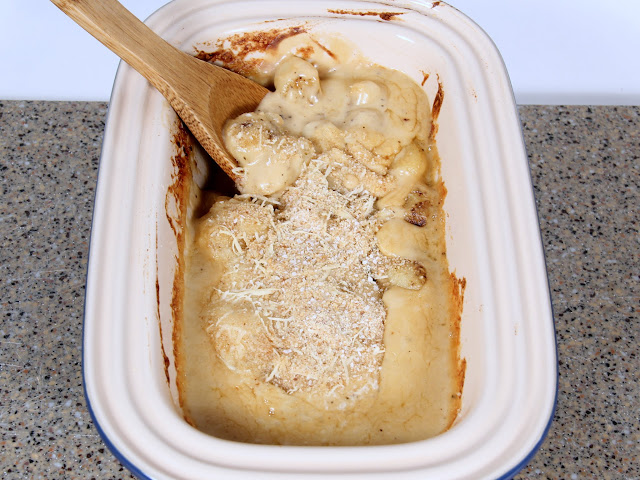
    Gratin dishes might be more common than one would think. Many Americans love gratin dishes like macaroni and cheese, perhaps thanks to the common boxed versions with powdered cheese. Gratin can be much, much better than a blue box of mac n cheese, and this Beer and Cheese Gnocchi Gratin proves it. I would imagine that my friend in Berlin would approve.


    Beer and Cheese Gnocchi Gratin


    Ingredients

    • 2 c Precooked gnocchi (or substitute fresh)
    • 2 T Unsalted butter
    • 2 T All-purpose flour
    • 4 c Whole milk
    • 1 c Amber Ale(or substitute a wheat ale)
    • 2 c Shredded cheese(I used Cheddar and Swiss)
    • 2 t Kosher salt
    • 2 t Black pepper
    • 2 t Nutmeg
    Cooking Directions
    1. Bring a pot of salted water to a boil. Cook 2 c packaged gnocchi until they float to the surface of the boiling water, strain and set aside.
    2. Melt 2 T of butter over medium heat, once melted slowly add 2 T of all-purpose flour while continuously whisking.
    3. When the roux is a thick consistency add 4 c of Whole milk and continue to whisk.
    4. Once the roux is incorporated into the milk, add 1 c of amber ale to sauce, whisk continuously.
    5. Add 2 c of shredded cheese in several batches. Whisk the whole time until the sauce is smooth.
    6. Add 2 t of Kosher salt, black pepper, and nutmeg to the beer and cheese bechamel sauce, when fully mixed take off of heat and reserve.
    7. Heat up a skillet, take the reserved gnocchi and lightly saute in butter. Once browned add to an oven proof dish and combine with beer and cheese bechamel sauce.
    8. Add freshly grated Parmesan cheese and bread crumbs over the top of your gnocchi and sauce mixture. Cook in the oven for roughly 30 minutes. To achieve a very brown crust, place the baking dish under the broiler for a few moments. Watch until you are satisfied with the color.
    Total Time: 1 Hour

    Citations and Further Readings:

    • "What is gratin?." Cookthink. N.p., n.d. <http://www.cookthink.com/reference/926/What_is_a_gratin >.
      Fried Green Tomatoes
      Winter is undeniably approaching. Southern Indiana has already seen one night in which temperatures dipped below 32F. The frost destroyed a large variety of plants including my precious tomato vines. Instead of dreading the inevitable barren season to come, I wanted to write an article about how we can still get great food in our post-frost world.

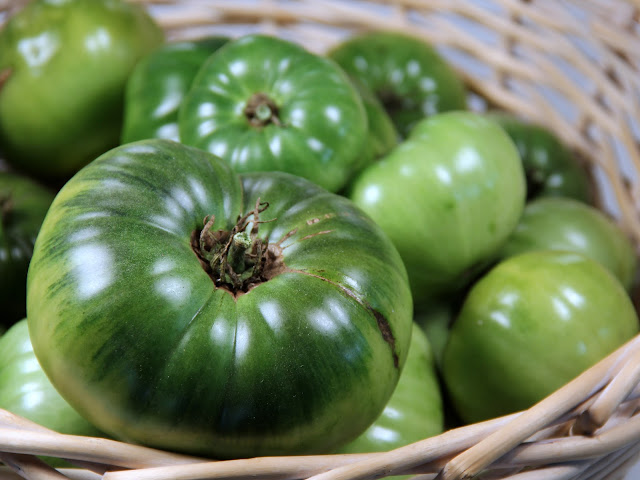
      Throughout the United States, one of the most common garden plants grown for food is the tomato. Tomatoes sugar content, acidity, and size all depend on the breed and growing conditions of the plant. A grape tomato and beefsteak tomato have considerably different usages. Tomatoes do share a common development cycle. All varieties of tomatoes start off as immature, hard, tart green fruits and only after maturating, they change color and develop unique flavors.

      However, if a tomato plant is unprotected in a below freezing environment, its vines will wilt and die. This seasonal event leaves many gardeners with a lot of unripened tomatoes. There are techniques to ripen green tomatoes such as; sun ripening, by storing green tomatoes on a window sill in direct sunlight, or ethylene ripening, this is done by storing green tomatoes in a closed bag with an ethylene producing fruit. However, green tomatoes have culinary validity in their own right!

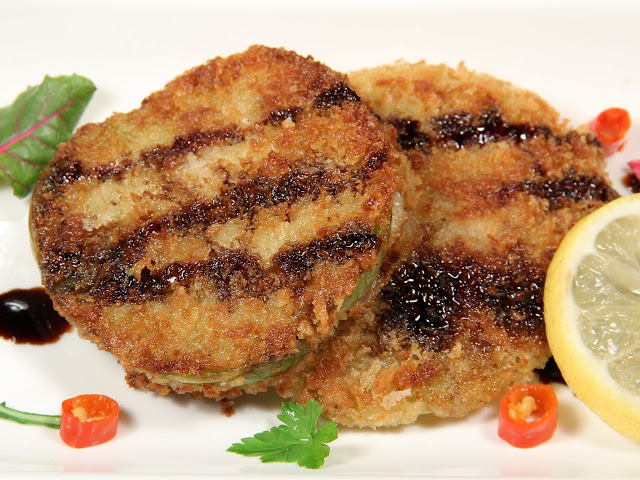
      Fried green tomatoes are a common usage of the unripened fruit. When cooked, they become tender yet remain flavorful. You may beer batter, tempura batter, use bread crumbs, crackers, or any other variation of breading or battering food that you prefer.

      Many of us think of fried green tomatoes as a recipe developed in the Southern United States, and this is primarily due to the novel and film Fried Green Tomatoes which takes place in Alabama. Lisa Bramen from Smithsonian.com has found that fried green tomatoes started to appear in the United States in the North and Midwest, and were most likely the contribution of Jewish immigrants from the mid 19th to early 20th century. Regardless of who can claim ownership of fried green tomatoes, they only seem to be gaining in popularity. Fried green tomatoes are another instance of practicality becoming a valued American food tradition.

      Green Tomatoes


      Fried Green Tomatoes

      Ingredients
      • 6 Large green tomatoes
      • 1/4 c Buttermilk
      • 2 Eggs, whisked
      • 1 c All-purpose flour
      • 2 c Panko bread crumbs
      • 5 T Old Bay seasoning
      Cooking Directions
      1. Slice green tomatoes, about 1/4-1/2 inch thick.
      2. In a bowl beat eggs and buttermilk together.
      3. On a separate plate mix flour and Old Bay seasoning together.
      4. On yet another plate spread Panko.
      5. Take a slice of tomato and dredge in flour, then coat it in the egg mixture, and finally coat with Panko crumbs. Carefully set breaded tomato on a sheet pan lined with wax paper.
      6. Repeat the process until all tomatoes are breaded, then stick in the freezer.
      7. One hour to indefinite, remove the frozen tomato and prepare oil to fry. You want to make sure and use a high heat oil and get it near its smoking point. The frozen tomatoes will instantly drop the temperature of the oil, so this part is crucial.
      8. Fry the tomatoes until golden brown and remove to a plate lined with paper towels. Make sure to absorb as much oil as possible and serve immediately to avoid soggy tomatoes.
      9. *The frozen tomatoes will last over the winter, fry off as desired.
      Total Time: 2 Hours

      Citations and Further Readings:

      • Braman, Lisa. "The Surprising Origins of Fried Green Tomatoes." Smithsonian. Smithsonian, 6 Aug. 2010. Web.
      Pancake Bread Pudding

      Unsustainable practices found in large scale food production, distribution, and commercialization are not primarily focused on nutrition, profit margins dictate our large scale food production and agriculture practices. There are many issues that I hope to address in future posts, but today I wanted to focus on food waste. Food waste is both a humanitarian and ecological issue, which neither mainstream journalism or politics has adequately addressed, yet almost every one of us is guilty of wasting food to varying scales. In fact, the USDA states that in 2010, 30-40% of the US food supply (about 133 billion pounds of food) were thrown out and never consumed. These numbers included retail food suppliers, restaurants, and home kitchens.

      133 billion pounds of food per year is an incredible amount of food to sit in a landfill for the rest of eternity, considering that a large portion of it could go to feeding hungry people or be used in agriculture to feed animals or compost. I do not have a cure-all solution for our food waste problem, but I do think that through better management, storage methods, and creativity our nation can reduce food waste especially in the home sector. That is why I want you to take a moment and think about what food you have thrown out in the past week. What steps could you have taken to preserve and utilize that food?

      This recipe came about after a Sunday pancake breakfast where I was faced with a wasteful dilemma of my own. There were plenty of leftover pancakes and despite a desire to trash the leftovers and be done with it, I started to brainstorm ways to re-purpose, and the result was a winning dessert. Bread pudding is a perfect way to save and re-purpose bread, or other dough/batter products, and it generally only requires staple pantry and refrigerator items.

      Pancake Bread Pudding


      Pancake and Blackberry Bread Pudding


      Ingredients
      • 1 & 1/2 c Whole milk
      • 3 c Pancake scraps, torn
      • 2 Large eggs
      • 1 c Sugar
      • 1 T Vanilla extract
      • 2 Blackberries per pudding
      • 1/2 t Cinnamon
      • 1/4 t Ground sage
      • Butter to coat tin
      Cooking Directions
      1. Coat cupcake tin with butter and preheat oven to 350 .
      2. Add milk and pancake scraps into a bowl and combine with hands.
      3. Mix eggs, sugar, vanilla extract, and spices in a separate bowl.
      4. Combine both bowl's contents and mix.
      5. Pour batter into cupcake tin.
      6. Stick 2 blackberries in each cupcake.
      7. Bake for 40 minutes or until set.
      8. Let sit for 10 minutes then remove and transfer to a wire rack.
      Total Time: 1 hour
      Citations and Further Readings:
      • "USDA and EPA Launch U.S. Food Waste Challenge Calls on both Public Sector and Private Industry to reduce food waste." www.USDA.gov. USDA, 4 June 2013. Web.
      Sweet Potato Bun

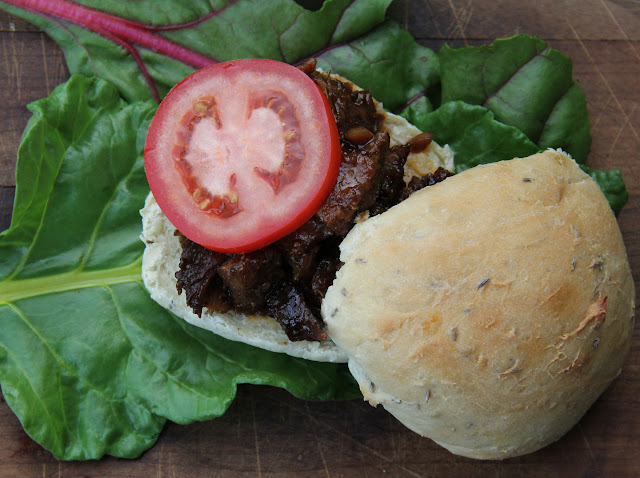
      I lead a pretty hectic life. Work takes up a considerable amount of time, so much time that I often can not schedule in special projects like smoking a brisket or pork shoulder, which happens to be an all-day affair. Luckily, a month ago I had the day off and somehow managed to divert all extraneous responsibilities so that I could give my pork shoulder the love it needed. If I commit to a whole day of fire, smoke, and meat then why would I settle for anything less than a great sandwich bun? A pulled pork sandwich does not need to be complicated, great meat, great sauce, and a great bun, enough said.

      But what actually makes a great bun recipe? First, it is important to understand what a bun is. Buns, like all bread are actually a solidified foam. The active yeast in these potato buns feed on sugar, and as a byproduct create alcohol and carbon dioxide. The carbon dioxide gas expands in the gluten networks of the sweet potato bun which raises the dough. This gives a distinctly light and fluffy texture. When the bread reaches an internal temperature of 140 F the starch from the flour, and in this case the additional sweet potato puree, begins to gelatinize(Gisslen) creating an even chewier soft bun than usual. After the gelatinzation process, the foam will remain stable until consumption or disposal(Fresh bread spoils at a much faster rate than commercial breads full of preservatives).

      Potato buns are not an uncommon baked good, they are actually found in various cuisines throughout the world. Some potato breads are denser and pancake-esque like the Potato Farls from Ireland(Dimbleby). The American version is fluffy and chewy, which makes a desirable white bread. I was texturally interested in the American version of potato bread, but I thought it would be fun to experiment to try and coax out a subtle sweet potato flavor.

      Chemically there are some variances between potatoes and sweet potatoes. Potatoes contain more potassium which makes yeast rise faster (Gordon) but sweet potatoes contain more sugar, which yeast consume as food. I did not find the chemical differences between the two tubers substantial. The result of this recipes was a successful potato bun, which was perfect for my smoked pork sandwich. I would also suggest trying these buns with either burgers or a marinated and grilled Portobello mushroom sandwich.

      Sweet Potato Bun


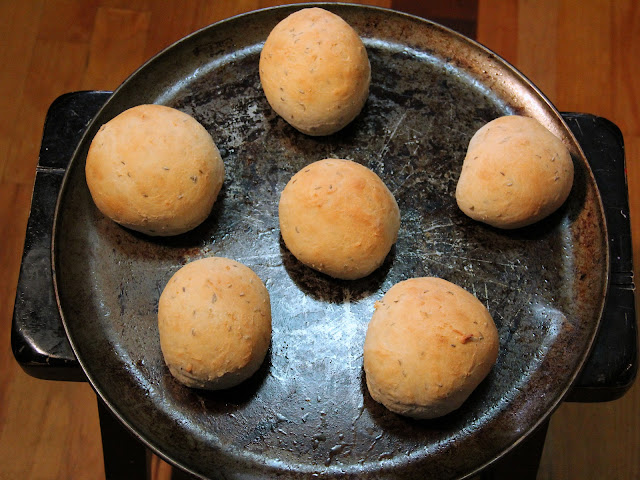
      Sweet Potato Bun


      Ingredients
      • 3 c All-purpose flour
      • 1/3 c Sweet potato puree
      • 1 t Kosher salt
      • 2 t Yeast
      • 1 c Water, lukewarm
      • 2 t Caraway seed
      Cooking Directions
      1. Set a pot of water to boil on high, afterwards peel sweet potato.
      2. Measure out 1 cup of lukewarm water and add the yeast. This process is called blooming.
      3. Cube and add to pot of water once boiling, cook until mash-able.
      4. Puree sweet potato.
      5. Add bloomed yeast water, 1/3 cup sweet potato puree, 3 cups of AP flour, sugar, caraway seed, and salt to a stand mixer or alternatively a stainless steel bowl and mix by hand.
      6. Once thoroughly integrated cover with a damp cloth or plastic and let proof for 1 hour.
      7. Separate into 6 individual buns and let proof for an additional 30 minutes.
      8. Add oil on top or an egg wash with a sprinkle of caraway seeds to top.
      9. Cook for roughly 20 minutes or until done at 350F
      Total Time: 2 hours

      Citations and Further Readings:
      • Dimbleby, Henery. " The easy way to make potato farls ." The Guardian. The Guardian, 14 Mar. 2014. Web.
      • Gisslen, Wayne. Professional baking. John Wiley & Sons, 2012.
      • Gordon, Megan. "Four Reasons Why Potato Buns Rule." The Kitchn. N.p., 19 July 2012. Web