
Showing posts with label Persian. Show all posts
Faloodeh Cocktail

Today's post will be short and sweet. I have been getting a lot of use out of my ice cream maker this summer, and the results have been great. Check out these Matcha Pecan and Chocolate Shiso ice creams for pictures and recipes. I wanted to demonstrate that there were even more fun uses for your home ice cream maker. Ice cream makers can be used to make slushies for the family, or adult frozen beverages.

Americans love frozen Margaritas and frozen Pina Coladas. These sugary slushie cocktails are served in Mexican restaurants, hotel pools, and really anywhere that depends on 'spring break' to fuel its economy. I actually do enjoy all of these things, but a giant fishbowl filled with an alcoholic slushie is too sugary for my personal taste. That is why I would suggest making a frozen Margarita, Pina Colada, or Faloodeh cocktail at home. Homemade beverages allow for monitoring the quality and quantity of sugar and alcohol consumed, your body will thank you the next morning.

For the unacquainted, Faloodeh is a Persian frozen dessert, flavored with rose water and mixed with rice vermicelli noodles. The combination sounds somewhat odd, but the texture is addictive and the frozen rose water is unbelievably refreshing. Faloodeh is considered by many to be one of several proto-iced dessert's which eventually led to the creation of ice cream and sorbets. Faloodeh has been documented as early as 400 B.C.E. (Iran Gazette).

*If you wish to make a non-alcoholic version, simply omit the alcohol and add cooked then cooled rice vermicelli noodles, or omit the noodles as well and enjoy as a rose water sorbet. 


Faloodeh Cocktail


Faloodeh Cocktail


Ingredients
  • 1 T Rose water
  • 2 c Water
  • 1/2 c Sugar
  • 1/2 Lime, squeezed
  • 1/2 Lemon, squeezed & zested
  • 1/2 c Premium vodka
Cooking Directions
  1. Create simple syrup by combining water and sugar, bring to a boil in a heavy bottomed pan until the sugar dissolves. (I made a 4:1 water to sugar ratio for health reasons, it is more than adequate, but feel free to adjust to 2:1 or 1:1)
  2. Let thoroughly cool.
  3. Combine the rose water, simple syrup, citrus juice, zest, and vodka into a bowl.
  4. Mix in an ice cream maker until slushie consistency.
  5. Additional tip: To keep the slushie consistency longer chill your serving glass in the freezer for 30 minutes prior to serving.
Total Time: 30 min
Citations and Further Readings:
  • Han, Emily. " Recipe: Faloodeh (Persian Rose Water Ice)." The Kitchn. N.p., 28 Aug. 2009. Web.
  • Nate, Barksdale. "Snow in Summer: A Global History of Frozen Treats." Hungry History. History, 20 June 2014. Web.
  • "Shiraz Shirazi Faloodeh." Iran Gazette. N.p., n.d. Web.
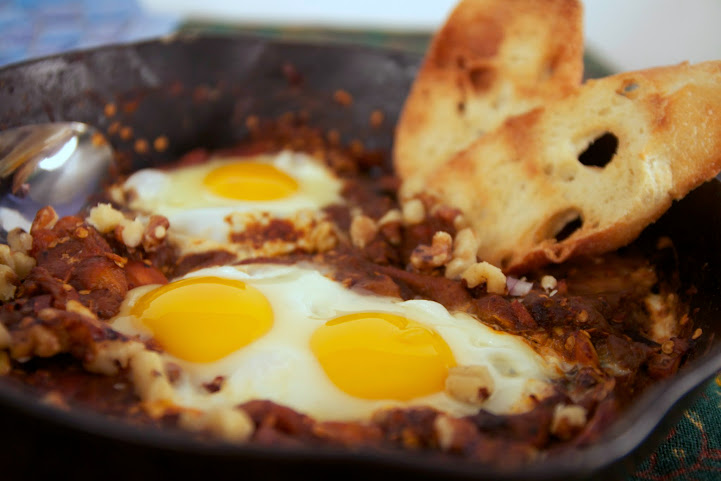
Middle East Egg and Eggplant Skillet To the average American citizen few regions of the world are more veiled in myth and misconception than the Middle East. This region is conceptually a fairly modern and Euro-centric area which spans a vast territory from Northern Africa all the way to Eastern Iran. The concept of what is now considered the Middle East may be traced back to the area that Arabian Muslims invaded after the Prophet Muhammad's death in 632 A.C.E (Husain).
Despite a heavy association with Islam the region known as the Middle East has diverse array of culture heritage and diversity that spans outside of Islam, which has helped define the region. The diversity and history of each unique region in the Middle east are reflected in their cuisine. For instance, breads in Egypt are extremely important, the importance of leavened bread is even directly referenced in the Old Testament. Across the Red Sea the diet of Saudi Arabia relies heavily on rice instead of bread, as well as the heavy use of chicken and lamb. The food ways of these areas may share some overlapping dishes, but they also intertwine with each geographical areas history.

Mesopotamia, the cradle of civilization, was found in between the Tigris and Euphrates river in modern-day Iraq. This is where scholars have been able to trace back the earliest signs of civilization in the Western world. The growth of civilization in Mesopotamia was due to the the fertile land and adoption of agriculture. Agriculture allowed for a larger production of food, which could support a larger population than the simple hunter and gatherers of their ancestors, who were more focused on finding their next meal than building upon a lexicon of unique culinary traditions.

This region also has an expansive history of cuisine influence through trade. The silk road ran directly through the Middle East. Foreigners were constantly traveling through the region, bringing along their own cultural traditions as well as spices and produce from other regions. For example, the Chinese tradition of pasta making was described in a Middle Eastern text centuries before it was known to come to Europe, "a 9th century Syrian text gives the Arabic name Itriya to a preparation of semolina dough shaped into strings and dried." (McGee, 572)

Because of this diversity of culture, spices, and produce all found the Middle East, unique areas all throughout the region developed some incredible culinary traditions, which I hoped to honor in this dish, a humble yet delicious fusion. I wanted to fuse a North Iranian breakfast dish known as Mirza Ghaseni, which is an egg and eggplant mixture with Shakshuka, a North African (Clark) egg and tomato sauce stew. This skillet can either be served as an appetizer or an entree, and the exclusion of the eggs makes the meal completely vegan, if dietary restrictions demand.

Middle East Egg and Eggplant Skillet


Middle East Egg and Eggplant Skillet


Ingredients
  • 1 Large eggplant
  • 2-3 Eggs
  • 4 Garlic cloves, minced
  • 2 Large tomatoes, medium dice
  • 1 T Tomato paste
  • 1/2 t Turmeric
  • 1/2 t Smoked paprika
  • Walnuts, crushed as a garnish
  • salt to taste
Cooking Directions
  1. Preheat oven to 400F
  2. Slice eggplant in half length-wise, and lightly coat the exposed flesh in oil.
  3. Place the eggplant on a sheet pan skin-side up. with a sharp knife poke several holes in the skin of the eggplant. Roast for 40 minutes.
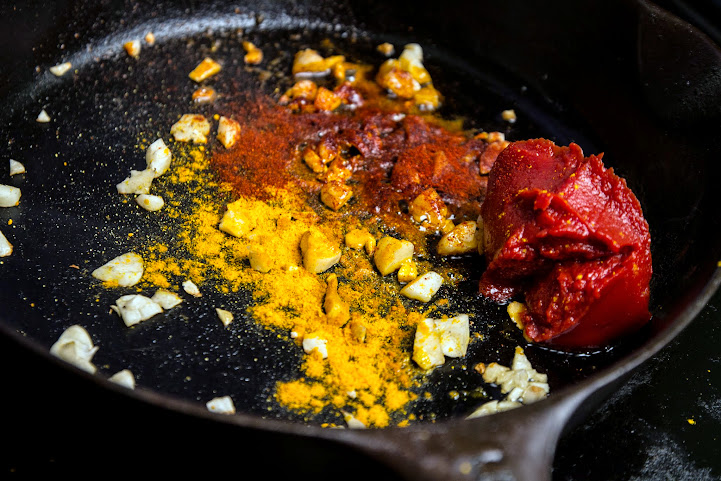
  4. While eggplant is roasted cook minced garlic in a skillet for 2 minutes on medium heat, add tomato paste, tumeric, and smoked paprika and cook for another 2 minutes. Add freshly diced tomatoes to the skillet and cook for another 10-15 minutes.
  5. When eggplant is done cook scrape the flesh from the skin and add to the skillet mixture. Salt skillet mixture to taste.
  6. Turn the heat to medium low and make several holes in the skillet mixture so that the skillet surface shows. Crack several eggs into the holes made, so they come in direct contact with the metal surface.
  7. Cook the whites of the eggs through, then garnish with crushed walnuts.
Total Time: 1 hour

Citations and Further Readings:
  • Clark, Melissa. " Shakshuka With Feta ." Cooking. New York Times, n.d. Web. 15 Feb. 2015. <http://cooking.nytimes.com/recipes/1014721-shakshuka-with-feta>.
  • Husain, Salma. Islamic Food: with Healing Toucch. New Dehli: Roli Books, 2011. Print.
  • McGee, Harold. On food and cooking: the science and lore of the kitchen. Simon and Schuster, 2007.
Photo's by Jordan Henline
Lamb Kebab with Saffron Rice and Mint Yogurt Sauce

As the days start to shorten and the nights start to cool, it is a sad reality that summer is coming to it's end. To celebrate the season of growth and warmth, I feel it is only appropriate to keep the grill fired up as much as possible, to char and smoke my way through meal after meal. One of the best ways I can think of to enjoy the grill while paying homage to the great grill masters of the past is by recreating an ancient dish. The lamb kabab.

Lamb kabab has a somewhat contested origin, this is likely due to its first documented origins around the cross-cultural period of the silk road. However, based on the the word kebab which is an Arabic pronunciation of the Persian word kabab which means to roast or grill, and historical evidence documenting it in Persian literature the kebab(kabab) originated in the region now known as Iran. (Marks 296)

When kabab spread all around the world, specialty kababs were developed as well. Many different meats, spices, and techniques are used for kebab and there are even many different varieties in certain regions. In Iran alone there are kebabs for different types of meat whether ground beef, chicken tenderloin, or in the case of the kebab I cooked ground lamb.

Persian kabab is traditionally served with a side of rice, in the case of this recipe I made saffron rice. However, there are different variety of popular Persian rices, I recommend using a Middle Eastern or South Asian Basmati rice. I Also included a dusting of ground sumac berry over my kebab which is a popular seasoning for kebab in Iran. (La Times)

If you're wondering where you've heard of Sumac before it may be that you're a fan and familiar with this African/Middle Eastern/South Asian spice. The spice is simply the dried and ground Sumac berry. Chances are it sounds familiar to many Westerners because it is in the same family as Poison Ivy, Poison Oak, and of course Poison Sumac. However, this sour spice is not poisonous, just a delicate enhancer of grilled meat.

Nice Char

Lamb Kabab with Mint Yogurt Sauce and Saffron Rice 


Lamb Kabab

Ingredients
  • 1 pound Lamb, ground
  • 3 T Onion, minced
  • 2 T Garlic, minced
  • 2 t Dried mint
  • 2 t Kosher salt
  • 1/2 t Black pepper
  • 1/2 t Ground sumac spice
  • 1/4 t Cumin seed
Cooking Directions
  1. Thoroughly mix all ingredients by hand until the mixture becomes sticky.
  2. Let sit covered in a refrigerator for one hour.
  3. Fire up your grill, once ready cook kabab on skewers until the internal temperature reaches 165F or to desired doneness.
  4. Remove from skewer.

Yogurt Sauce

Ingredients
  • 6 oz Condensed whole milk yogurt
  • 1 T Fresh mint, minced
  • 1 T Garlic, minced
  • 1 t Kosher salt
  • 1 t Black pepper
Cooking Directions
  1. Whisk all items together, then reserve in a refrigerator until kabab is completed.
Total Time: 1 hour 30 min
Citations and Further Readings:
  • Marks, Gil. Encyclopedia of Jewish Food. N.p.: John Wiley and Sons, 2010. 296. Print.
  • "Recipe: Iranian Chelo Kebab." The Los Angeles Times. LA Times, n.d. Web. 4 Sept. 2014. <http://www.latimes.com/food/la-fo-iranian-kebab-story.html>.
Photos by Jordan Henline