Showing posts with label Fried. Show all posts
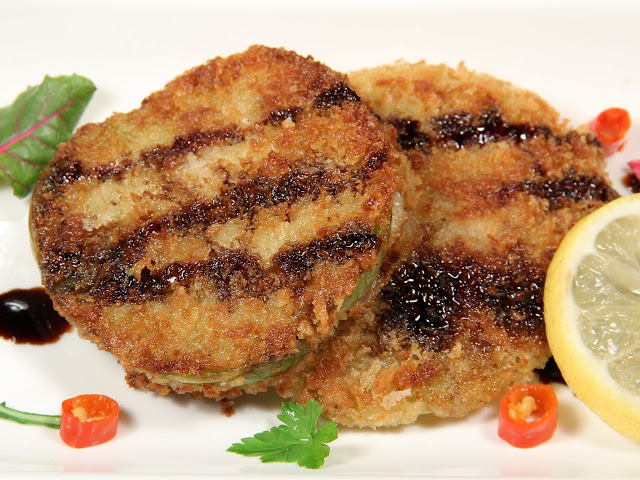
Fried Green Tomatoes
Winter is undeniably approaching. Southern Indiana has already seen one night in which temperatures dipped below 32F. The frost destroyed a large variety of plants including my precious tomato vines. Instead of dreading the inevitable barren season to come, I wanted to write an article about how we can still get great food in our post-frost world.

Throughout the United States, one of the most common garden plants grown for food is the tomato. Tomatoes sugar content, acidity, and size all depend on the breed and growing conditions of the plant. A grape tomato and beefsteak tomato have considerably different usages. Tomatoes do share a common development cycle. All varieties of tomatoes start off as immature, hard, tart green fruits and only after maturating, they change color and develop unique flavors.

However, if a tomato plant is unprotected in a below freezing environment, its vines will wilt and die. This seasonal event leaves many gardeners with a lot of unripened tomatoes. There are techniques to ripen green tomatoes such as; sun ripening, by storing green tomatoes on a window sill in direct sunlight, or ethylene ripening, this is done by storing green tomatoes in a closed bag with an ethylene producing fruit. However, green tomatoes have culinary validity in their own right!

Fried green tomatoes are a common usage of the unripened fruit. When cooked, they become tender yet remain flavorful. You may beer batter, tempura batter, use bread crumbs, crackers, or any other variation of breading or battering food that you prefer.

Many of us think of fried green tomatoes as a recipe developed in the Southern United States, and this is primarily due to the novel and film Fried Green Tomatoes which takes place in Alabama. Lisa Bramen from Smithsonian.com has found that fried green tomatoes started to appear in the United States in the North and Midwest, and were most likely the contribution of Jewish immigrants from the mid 19th to early 20th century. Regardless of who can claim ownership of fried green tomatoes, they only seem to be gaining in popularity. Fried green tomatoes are another instance of practicality becoming a valued American food tradition.
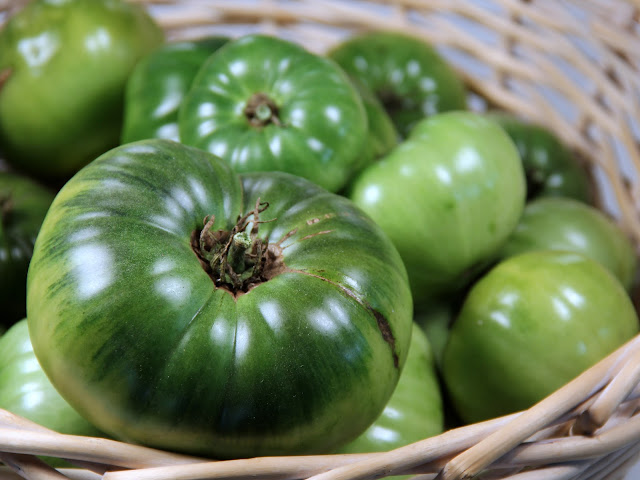
Green Tomatoes


Fried Green Tomatoes

Ingredients
  • 6 Large green tomatoes
  • 1/4 c Buttermilk
  • 2 Eggs, whisked
  • 1 c All-purpose flour
  • 2 c Panko bread crumbs
  • 5 T Old Bay seasoning
Cooking Directions
  1. Slice green tomatoes, about 1/4-1/2 inch thick.
  2. In a bowl beat eggs and buttermilk together.
  3. On a separate plate mix flour and Old Bay seasoning together.
  4. On yet another plate spread Panko.
  5. Take a slice of tomato and dredge in flour, then coat it in the egg mixture, and finally coat with Panko crumbs. Carefully set breaded tomato on a sheet pan lined with wax paper.
  6. Repeat the process until all tomatoes are breaded, then stick in the freezer.
  7. One hour to indefinite, remove the frozen tomato and prepare oil to fry. You want to make sure and use a high heat oil and get it near its smoking point. The frozen tomatoes will instantly drop the temperature of the oil, so this part is crucial.
  8. Fry the tomatoes until golden brown and remove to a plate lined with paper towels. Make sure to absorb as much oil as possible and serve immediately to avoid soggy tomatoes.
  9. *The frozen tomatoes will last over the winter, fry off as desired.
Total Time: 2 Hours

Citations and Further Readings:

  • Braman, Lisa. "The Surprising Origins of Fried Green Tomatoes." Smithsonian. Smithsonian, 6 Aug. 2010. Web.
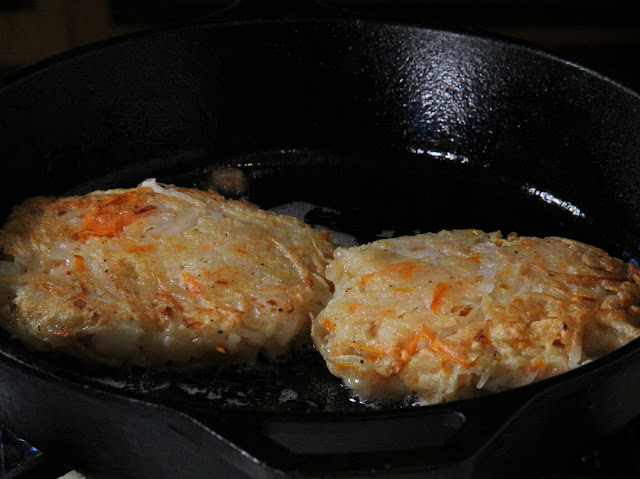
Potato and Carrot Latke

The total freedom of experimentation while writing Joy and Feast articles is extremely gratifying. Sometimes my experiments come from what produce I can source fresh, other times I find inspiration from a myriad of books or articles that cross my table. Sometimes I am able to explore food which has a significant meaning to me. Latkes or potato pancakes are a food that I have been acquainted with my entire life, I have wanted to write an article about them since I began this blog.

Potato pancakes are consumed during the Jewish holiday of Hanukkah, this is actually a fairly recent tradition. Jews, particularly in Western Europe have been consuming fried cheese pancakes for Hanukkah since the late middle ages. It was not until the mid-1800's when a series of crop failures in Ukraine and Poland forced farmers to plant potatoes, a nightshade crop from the new world. Perhaps this abundance of potatoes influenced the adoption of potatoes in place of cheese pancakes during this period. Potato latkes have remained prominent ever since. (Avey) Fried potato pancakes span well beyond Jewish culture, potato pancakes are regularly enjoyed throughout Central and Eastern Europe, as well as in the Middle East.

Often "traditions" or in this case traditional foods are confined to a dogmatic perception of culture, when in reality culture is fluid. Culture reacts to influences both internally and externally. Modernity has allowed cooks access to more information, ingredients, and communication than at any other point in human history. Lines have always been blurred, and we will continue down this path. Therefore, I believe that looking at one cultures "traditional food" through the lens of another culture can inspire some pretty creative and delicious meals.

The lens that I envisioned today's recipe through took influence from India's great culinary tradition. Firstly, it is worth noting that the nation of 1.2 billion people (World Bank) has different cultural and food traditions depending on region within the country. India has influenced and been influenced by far flung cultures and empires for millenniums. The silk road encouraged the trade of spices in which eastern and western cultures passed through India and left their mark. In addition, India contains tropical (wet and dry), sub-tropical, and mountain climates allowing for a diverse spectrum of agrarian potential.

What I love about Indian flavors is how the cuisine embraces pungency, spiciness, and boldness. A basic fresh apple puree, can become addictive with the right use of Indian spices. Garlic, ginger, and chili is a common trinity throughout tropical latitudes. Bold Indian flavors with Potato latkes make an unforgettable dish.

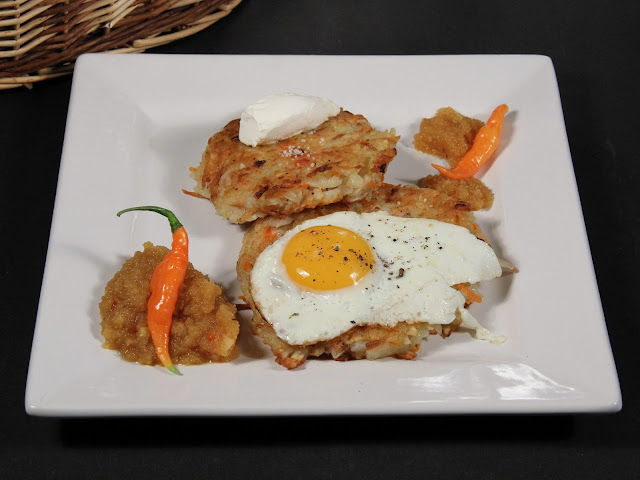
Potato and Carrot Latke
Potato and Carrot Latkes with Indian Spiced Apple Sauce


Potato and Carrot Latkes


Ingredients
  • 6 Russet potatoes, peeled
  • 2 Large carrots, peeled
  • 1 White medium onion, diced
  • 2 Large eggs
  • 1 c All-purpose flour
  • to taste salt & pepper
Cooking Directions
  1. Shred potatoes and carrots, I stored mine in acidulated water. That is water with about 1 t of lemon juice or vinegar. Omit this step if cooking latkes right away
  2. If stored in water make sure to thoroughly dry, extra moisture is bad for latkes
  3. Combine diced onion, shredded potatoes & carrots, eggs, and 1 c of flour into a mixing bowl. Season to taste.
  4. Heat up a pan over medium high heat with enough oil to cover the bottom.
  5. Patty out latkes and add them to pan once the oil sizzles when droplets of water touch, or over 350F. The thinner the latke, the easier it will be to cook through the center. Take care not to crowd the pan.
  6. When the latke starts to brown around the side, flip and cook until browned on the other side.
  7. When finished quickly pat dry with a paper towel to absorb excess oil, then place into a pan with a rack in a low temp oven while the rest of the batches of latkes finish.

Indian Spiced Apple Sauce


Ingredients
  • 4 Medium sized sweet apples, peeled and cored
  • 2 t Ginger, minced
  • 1 t Garlic, minced
  • 1-3 Chilies, sliced
  • 1/2 Lemon, juiced & zested
  • 1 Star anise
  • 1 Green cardamom pod
  • 5-8 Peppercorns
  • 1/4 t Brown mustard seed
  • 1/8 t Cumin seed
  • salt to taste
Cooking Directions
  1. Start with 4 medium sized ripe and sweet apples. Peel, core, then puree and set aside.
  2. Toast star anise, cardamom pod, peppercorns, brown mustard seed, and cumin in a dry skillet over medium high heat, constantly toss. Once the mustard seeds start to pop take off heat.
  3. Make a sachet with the toasted spice mix.
  4. Add vegetable or coconut oil to a pan and brown ginger and garlic for about a minute over medium high heat. Add the chilies and cook for another minute, constantly tossing or stirring.
  5. Add the apple puree into the garlic, ginger, chili mixture, and add about 2 T of water. Reduce heat to medium low. Add satchet of spices and cook for roughly 15 minutes.
  6. If to much water evaporates add more until a proper consistency and the spices meld with the sauce.
  7. Zest lemon and squeeze juice directly into the mixture. Add salt to taste and let cool to room temperature. Toss sachet when finished.
Total Time: 1 hour
Citations and Further Readings:
  • Avey, Tori. "Discover the History of Latkes During Hanukkah." Food. PBS, 12 Dec. 2011. Web.
  • "The Commonly Used Indian Spices." eCurry. N.p., 24 Aug. 2008. Web. 24 Aug. 2015.
  • "Total Population (in number of people)." The World Bank. World Bank, n.d. Web.
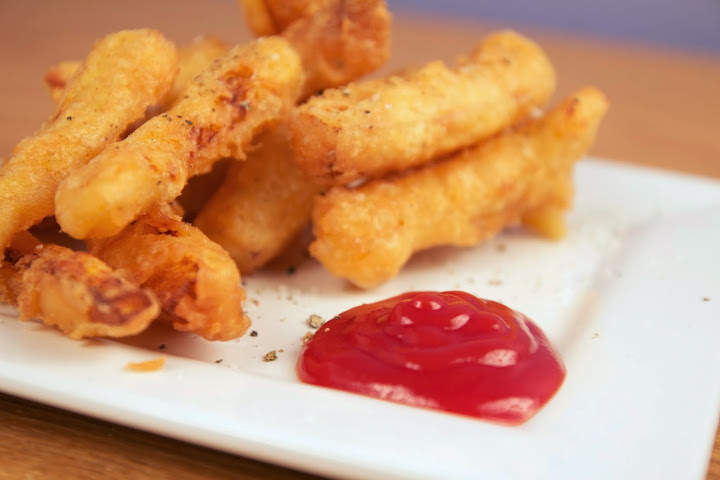
Beer Battered Delicata Squash Fries

Who doesn't love french fries? People love french fries all over the world. In fact, frozen french fries top the list of exported U.S. potato products, they account for more than half of the total potato export volume. In 2009 the United States exported 3 billion pounds of frozen french fries (USDA). French fries have a special place in our collective hearts and arteries, whether it's a burger with fries or fish and chips, fried potatoes are not going anywhere.

With all due respect to the fried potato, it's not a completely seasonal vegetable, despite the ability to purchase in supermarkets year-round, potatoes are generally considered an autumn crop in most regions of the United States. Using seasonal ingredients and engaging cherished food traditions can go hand in hand with a little bit of creativity, and by following my theory of frying starchy vegetables you may adapt or expound upon the recipe in this article. This simple theory is starchy vegetable + beer batter + deep frier = good stuff. Nature loves variation and so do I, so changing the vegetable and therefore recipe for fries depending on season only makes sense.

The current season is winter, and hearty winter squash are wonderful for sustenance throughout the winter. This is partially because winter squash can be kept inside the home at room temperature for months if properly hardened during harvest. I personally believe winter squash, which includes the popular pumpkin, butternut squash, and of course delicata should be kept in everyone's home during this season of scarcity.

To better explain how winter squash last so long I will chemically compare them with their close cousins, summer squash which include zucchini and pan squash. 90% of winter squash's calories come from carbohydrates and 50% of those carbohydrates are starch(TWHF), this starch sustains the winter squash for a duration of months due to the slow conversion of starch to sugar over time. Summer squashes do not have the same lifespan as winter squash because their energy source is largely composed of the carbohydrate glucose, this is also known as the sugar in ones blood sugar. Vegetables which keep stores of energy for long periods of time like winter squash or tubers such as potatoes slow release energy due to their starchy composition and low water composition are the ideal candidates for seasonal frying.

Besides being a good source of starchy energy, winter squash are full of vitamin A, and a good source of vitamin C and fiber (TWHF). In fact using Nutritiondata.self.com to compare overall nutrition with potatoes, winter squash are both more filling and more nutritious.

Delicata squash have a delicious and semi-sweet squash taste. When covered in the beer batter and fried, the squash melts in your mouth. It's not a potato, and I promise you that is a good thing. Feel free to try with different winter squash varieties such as pumpkin or kabocha for slight variants on taste. 

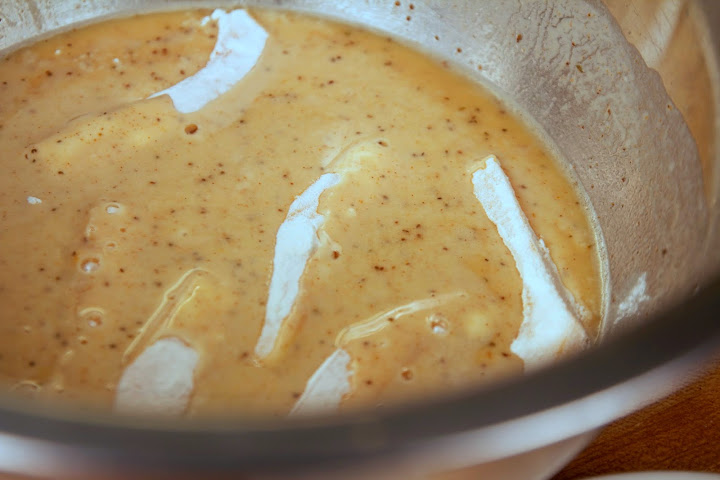
Battered Frying

Beer Battered Delicata Squash Fries


Ingredients
  • 1 Delicata squash
  • 1 c All-purpose flour, & enough to coat
  • 1 Large egg, beaten
  • 2 t Old Bay seasoning
  • 1 bottle of wheat ale
  • Enough High heat oil to fill a pot 3-5 inches
Cooking Directions
  1. Combine 1 cup of flour, egg, old bay spice, and bottle of beer and whisk until combined.
  2. Slice off the skin of the squash.
  3. Scrape out the interior of the seeds, reserve for other use.
  4. Slice the squash into a thick julienne, I prefer them larger.
  5. Dredge the squash slices in enough all purpose flour to coat.
  6. Drop the dredged slices into the prepared beer batter.
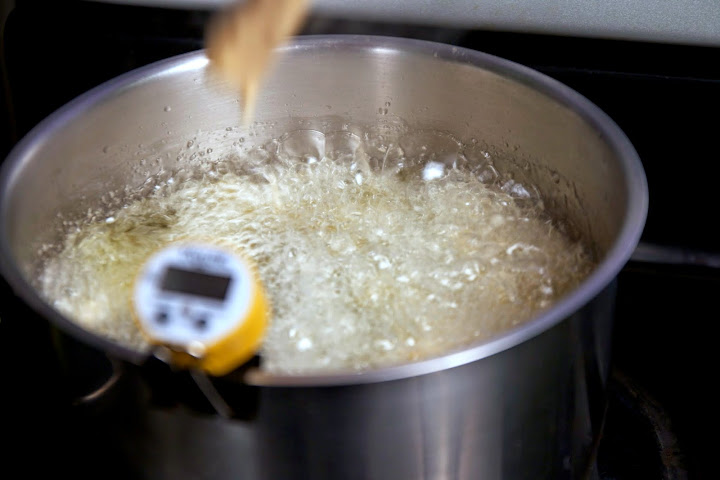
  7. Carefully drop the battered fries into a pot of oil at 375 F until they float to the top. Roughly 3-5 minutes.
  8. Remove from oil and quickly absorb excess oil with a paper towel.
  9. Season with salt and pepper.
Total Time: 15 min
Citations and Further Readings:

  • Bond, Jennifer K. "Potatoes." United States Department of Agriculture Agricultural Research Service. USDA, 7 Oct. 2014. Web. 3 Feb. 2015. <http://www.ers.usda.gov/topics/crops/vegetables-pulses/potatoes.aspx#trade>. 
  • Carrera, Amy L. "Carbohydrates in Zucchini." Livestrong.com. N.p., 28 Jan. 2015. Web. 3 Feb. 2015. <http://www.livestrong.com/article/459868-carbohydrates-in-zucchini/ >. 
  • "Squash, Winter." The Word's Heathiest Food. The George Mateljan Foundation, n.d. Web. 3 Feb. 2015. <http://www.whfoods.com/genpage.php?tname=foodspice&dbid=63 >.
Photos by Jordan Henline
Habanero Popper

Innovation is generally a great thing. Bridging the gap between creativity and necessity is a hallmark of the evolution of our species. I am all about expanding humans conceptual horizon. That being said, sometimes when something isn't broken, don't fix it. This recipe is the result of my friend and I brainstorming the type of food we would want to eat while drinking a beer on the front porch. Jalapeño poppers came up early in the conversation, then we thought it would be fun to kick up the heat a little bit and try a spicier variety of chili. Habaneros were an obvious choice due to their unique flavor and ease of accessibility, most major super markets carry fresh habaneros so this was an easy substitution for the common jalapeño popper.

Habanero peppers are one of many different chili varieties found throughout the world, this includes Hungarian paprika chilies, Thai or Indian bird eye chilies, and Peruvian aji chilies. Chilies are different from the old world varieties of spices known as pepper, such as the black peppercorn and Szechuan pepper. Peppercorns are actually dried berries, while chili peppers are a new world fruit from the nightshade family. The nightshade family also includes plants like tomatoes and eggplants(McGee 329), as a side note one should never consume any flower from the nightshade family, even though their fruits are adored all over the world..

The chili pepper has an amazing story of international distribution and acceptance in the age of European imperialism and international trade. However, mankind was not responsible for chilies originally being spread throughout the New world, chilies are biologically designed to be eaten by birds. The birds gobble up the chili fruit whole without damaging the chili seed. When the seed is damaged the chemical compound capsaicin is released, this is what gives chilies its distinct burning sensation. After consumption birds would later distribute the chili seeds through their droppings during migration.

The old world has been enjoying the spread of chilies since the mid-15th century(Wallin), Portuguese sailors brought chilies from Bahia and Pernambuco in Brazil across the Atlantic, then later Africa and India via Indian Ocean trading routes. Around the same time the Spanish took the chili pepper from the port cities of Acapulco, Mexico and Lima, Peru across the Pacific ocean to Manila in the Philippines and then to other parts of Asia(Bloch-Dano, 91-92).

Habaneros are known to be able to be exceptionally hot variety of chili. Both the genetic makeup and growing conditions determine the heat of any particular chili(McGee, 419). Like their chili brethren, habanero's ancient lineage originated in South America, the species made its way north and eventually developed in the Caribbean. 

The chili is widely used and cultivated in the Yucatan Peninsula of Mexico, in fact it is one of the only chilies grown in the Yucatan without a Mayan name(Whole Chili Pepper Magazine). The name Habanero is a Spanish reference of the chili being from Havana, Cuba. These chilies are also known as Scotch Bonnet is Jamaica and the Bahamian Pepper throughout the Bahamas.

The habanero will bring an intense heat to this dish, so a fatty sauce was necessary to balance out the dish. The sweet chili mayonnaise in this recipe can be used as a dip or spread for anything. I find its usage is great with fried foods, sandwich spreads, or thinned with vinegar to make a creamy salad dressing. I would suggest starting out with a high quality mayonnaise, if you live in the Southern US or on the East Coast check out Duke's Mayonnaise, For vegans check out Just Mayo, or simply make the mayonnaise yourself.


Habanero Pepper Poppers with Sweet Chili Mayonnaise


Habanero Pepper Poppers with Scallion Chili Mayonnaise


Habanero Pepper Poppers

Ingredients
  • 8 Habanero chilies
  • 2 Large eggs, beaten
  • Enough All-purpose flour to coat
  • Enough Panko to coat
  • Enough Cream cheese to stuff
Cooking Directions
  1. Using gloved hands, remove the stem of the chili with a knife, then cut in half. Remove the innards including the seeds.
  2. Stuff the inside with cream cheese, then place the two halves of the chili back together.
  3. Roll stuffed chili in all purpose flour.
  4. Dip the dredged chilies in a separate bowl containing the beaten eggs.
  5. Roll the chilies that have now gone through the beaten eggs in panko, gently set aside.
  6. Lightly drop the stuffed chilies in a high heat oil at 375F.
  7. Cook for about 3-6 minutes, remove when golden brown.
  8. Pat dry with a paper towel to remove excess oil, sprinkle salt and pepper over.

Sweet Chili Mayonnaise

Ingredients
  • 1/2 c High quality mayonnaise
  • 2 T Sweet chili sauce
  • 1 Scallion
Cooking Directions
  1. Slice scallion as thin as possible.
  2. Mix all ingredients together and place in a serving ramekin.
Total Time: 15 min
  • Bloch-Dano, Evelyne. Vegetables: A Biography. Chicago: University of Chicago Press, 2012. 91-92. Print.
  • McGee, Harold. On Food and Cooking. New York: Scriner, 2004. 329, 419. Print
  • "Profile of the Habanero Pepper". Whole Chile Pepper Magazine. July 1989. Retrieved 2013-04-14
  • Wallin, Nils-Bertil. "Chili: Small Fruit Sets Global Palettes on Fire." Yale Global Online. YaleGlobal, n.d. Web. 4 Jan. 2015. <http://yaleglobal.yale.edu/about/chili.jsp>.
Photo's by Jordan Henline
Catfish Tempura

I have fond memories from my youth of catching channel catfish in a neighborhood retention pond. Back in those days, catching catfish was only an after school hobby. Little did I know that later in life I would come back to this common catfish with a new found respect. Farm-raised catfish are very affordable, a pound of nuggets can cost as low as $4.99 depending where you purchase from. Catfish are also relatively healthy, They contain large amounts of Protein, Vitamin D, and Potassium, among other vitamins and Minerals (nutritionfacts.com). Catfish tempura is a cross-section of conscious, sustainable fishing and indulging in cherished culinary traditions.

Not all catfish are created equal. Catfish can be a great fish option, but it is important to keep an eye out and purchase farmed fish specifically from the US if possible. US cat-fisheries are highly regulated and managed in an environmentally healthy way (Seaver). In addition, they are raised on a primarily vegetarian diet including rice and soy beans. This diet helps control the flavor of the fish and eliminates the "muddy taste" of some wild caught catfish. Foreign caught or raised catfish like Swai, Tra, Basa, River or Striped catfish are not raised in the same regulated conditions as those of the US
(Seafoodwatch.org), so quality may vary significantly.

Corn-breaded and deep fried catfish have a rooted tradition in the the Southern United States. The popularity of this fish only continues to grow in the United States, reaching far beyond Mississippi and Georgia. I wanted to take this tradition of fried catfish and combine it with another frying tradition, that of tempura. Tempura is a regarded style of airy deep frying which is generally associated with Japanese cuisine. Interestingly enough tempura's origins lie in Portuguese cuisine. Portuguese missionaries introduced the tempura style to Japan back in the 16th century C.E.(Moreida).

Despite appearing as a seemingly simple preparation, tempura really does involve a heightened attention to technique. One of the keys to a light and airy tempura is using very cold, carbonated water. When cold water is added to the other elements of the tempura batter it creates a more viscous mixture and holds onto the fish better. The carbonated liquid allows more gas in between the gluten networks for a lighter batter. Finally, by working quickly and not over-mixing the batter, the flour particles will not have enough time to fully soak up the liquid, the result is a crispy and uneven and lacy crust (McGee 214).

Every fried food deserves a good sauce. A sauce like soy sauce or ponzu would work well here, but I wanted to make a sauce based off of the Japanese tentsuyu, which is generally considered an all purpose sauce. The preparation is pretty simple and the result is a blend of sweet, salty, savory, spicy. I would suggest preparing the dashi (first sea stock) in advance. If you are unfamiliar with dashi, there are variances on stock but at it's most basic form it's kelp and dried tuna flakes. Dashi, and other Japanese stock recipes can be viewed in This Dashi Guide.
Sauce


Catfish Tempura with Tempura Dipping Sauce


Masaharu Morimoto Tempura Batter (The New Art of Japanese Cooking)

Ingredients
  • 2 Large egg yolks
  • 1/2 c Vegetable oil
  • 1 & 1/2 c Seltzer water, chilled
  • 2 c Tempura flour (All-purpose can be substituted)
Cooking Directions
  1. Beat the egg yolks in a bowl
  2. Slowly whisk in the oil until blended
  3. Add the tempura flower and stir with chopsticks until just combined. (residual flour on top is okay, Don't overmix!)

Dashi Tamari Tempura Dipping Sauce

Ingredients
  • 1 c Dashi
  • 2 T Tamari(Use 2.5-3 T if substituting soy sauce
  • 2 T Hoisin sauce
  • 2 T Ginger, minced
  • 2 T Daikon, minced
Cooking Directions
  1. Mince ginger and daikon.
  2. Add all ingredients to a small sauce pan over medium heat.
  3. Cook for 15-20 minutes on medium.

Catfish Tempura

Ingredients
  • 1 pound Catfish nuggets
  • Tempura batter
  • Enough High heat oil to fill a heavy bottom pan 3-5 inches
Cooking Directions
  1. Preheat oil to reach 350-370F
  2. Dust catfish nuggets in AP flour
  3. Quickly dredge nuggets in tempura batter and lightly drop in the oil
  4. Cook 3-5 minutes or until the nuggets are floating and the batter is golden brown.
  5. Transfer catfish to a paper towel and dry off as much oil as possible.
  6. Season with salt and pepper and enjoy.
Total Time: 30 min
Citations and Further Readings:
  • "Catfish Recommendations." seafoodwatch.org. Monterey Bay Aquarium, n.d. Web. 10 Dec. 2014. <http://www.seafoodwatch.org/seafood-recommendations/groups/catfish/overview?q=Catfish>. McGee, Harold. On Food and Cooking. New: Scribner, 1984. 214. Print. 
  • Moreida, Takashi. "Tracking Down Tempura." Ed. Moreida. Kikkoman, n.d. Web. 10 Dec. 2014. <http://www.kikkoman.com/foodforum/thejapanesetablebackissues/06.shtml>. 
  • Morimoto, Masaharu. Morimoto: The New Art of Japanese Cooking. N.p.: DK Publishing, 2007. 260. Print. 
  • "Fish, catfish, channel, wild, raw." Nutritionfacts.com. Nutrition Facts, n.d. Web. 10 Dec. 2014. <http://nutritiondata.self.com/facts/finfish-and-shellfish-products/4036/2>.  
  • Seaver, Barton. For Cod and Country. New York: Sterling Epicure, 2011. 27. Print. 
  • Yoshizuka, Setsuko. "Tempura Dipping Sauce." About.com. About.com, n.d. Web. 10 Dec. 2014. <http://japanesefood.about.com/od/tempura/r/tentsuyu.htm>.
Photo's by Jordan Henline
Onion Ring Stack I am not here to argue the health benefits of deep fried food. Frankly, that is an argument that can not be won. However, we all occasionally have a craving to indulge in a crispy, crunchy, deep-fried treat. While beer battered onion rings may not be the healthiest side dish option, if you want to satisfy a craving but have feelings of guilt, why would you not want to be in control of the quality of what you're consuming? Feeling guilty is no good, instead of relying on fast-food chains whose primary concern is profit margin, I suggest take control and know exactly what is going into your body.

This recipe could not be easier or faster, and the finished plating is aesthetically pleasing to all guests. In addition, this recipe contains significantly less calories than the nearly 2000 calories found in a Blooming Onion (outback.com)! A few simple pantry items and one mnemonic device is all it takes for this perfect appetizer/side dish. I would suggest cracking open a dark brown ale at this point before before starting.

The first key to making beer battered onion rings is whipping up your batter. Batter is a pourable dough. A dough containing more liquid than solid, and because of that the gluten network does not fluff up like dough. Using either egg, baking powder, baking soda, (Ruhlman) or an alternative chemical leaven-er batter gains it's lightness.

By using the simple mnemonic device "1 batter", you can whip up a beer batter at anytime. 1 cup of all-purpose flour, 1 beaten egg, and 1 bottle (12oz) of a wheat ale fulfills all the necessary components for a beer batter. Need to double or triple the size of your batter? simply multiply batch size by 1. Feel free to season however you see fit, but Old Bay is generally a great all purpose seasoning.

Making onion rings at home really is customizable. You can slice the onion into large or thin slices, the size is personal preference and I like steak house rings. A quick dredge in unseasoned all purpose flour helps the batter cover and stick to the onion rings. Then all that is left is a quick bath in 350F oil. I use canola oil because it has a high smoke point and a fairly neutral flavor. But this is your treat, so feel free to substitute canola oil for peanut oil, suet, or maybe even duck fat.
Deep Fry

Beer Battered Onion Rings Stack

Ingredients
  • 2 c All-purpose flour
  • 1 Large egg, beaten
  • 2 t Old Bay seasoning
  • 1 Bottle of wheat ale
  • 1 Spanish onion(white onion)
  • Enough High heat oil to fill a pot 3-5 inches
Cooking Directions
  1. Heat up oil pot to reach 350F
  2. Slice a Spanish(white) onion about 1/2 - 1 inch thick to create rings.
  3. Combine 1 c flour, egg, Old Bay seasoning, and wheat ale in a separate bowl.
  4. Put the reserved 1 c of flour in a shallow plate.
  5. Take the onion rings and dredge in the flour on the plate.
  6. Drop the floured onions into the beer batter and cover.
  7. Then transfer to the oil, fry until golden brown and floating.
  8. Quickly dry the excess oil with a paper towel.
  9. Stack the rings up, large to small to create a tiered stack.
  10. Season with salt, pepper, and parsley.
Total Time: 15 min
Citations and Further Readings:

  • http://www.outback.com/nutrition. N.p., n.d. Web. 28 Nov. 2014.
  • Ruhlman, Michael. Ratio. New York: Scribner, 2009. 55. Print.
 Photos by Jordan Henline
Louisiana chicken wings

It’s no mystery that meat eaters love crispy wings. I love deep fried chicken, whether using a batter, breading, or just submerging the beautiful skin in fat. Crispy skin and tender chicken is one of my guiltiest pleasures. But why do people cherish the textural crisp and audial crunch on fried foods so much? “Crispness is one of the most important and desirable textural characteristics that signify freshness and high quality in breaded fried foods. Crispness appears to be the most versatile single textural characteristic in many foods.” (Antonova, Mallikarjunan, and Duncan)

Chicken wings can be an inexpensive food option. In my house, I buy whole chickens and break down the carcasses into different sections. I will not show you how I break down a chicken. I will let Chef John Placko demonstrate how to break down a chicken carcass. (Note: I personally use a small meat cleaver, but use whatever sharp knife you are comfortable with) After breaking down several chicken carcasses I always end up with a bag of wing pieces in the freezer. Utilizing this recipe is a perfect opportunity to clear out the freezer and transform one of the lesser-desired pieces of the chicken into an awesome snack or appetizer.

 I designed this recipe to use minimal ingredients. In fact, I specifically choose Louisiana hot sauce because it only contains three ingredients: cayenne pepper, white vinegar, and salt. The second purpose of this recipe is simply to demonstrate that understanding and properly executing simple techniques can create outstanding results. This is a no frills dish that is an absolute pleasure with each bite.
Cover in Louisiana hot sauce


Louisiana Chicken Wings

Ingredients
  • 1 bottle Louisiana brand hot sauce
  • 12 Chicken wings
  • Enough High heat oil to fill a heavy bottom pan 3-5 inches
Cooking Directions
  1. Let wings par-freeze 30 minutes before cooking.
  2. Drop wings in the fryer at 275F for 12-13 minutes
  3. Remove wings from oil, and quickly dry off with a paper towel, let rest for several minutes.
  4. Turn the heat on your fryer to high, when the oil temperature is 375F, fry wings for 5 minutes.
  5. Transfer wings to a cooling rack and remove oil with a paper towel.
  6. Place wings in a plastic container with a tight fitting lid, cover wings in Louisiana hot sauce and shake. Serve immediately.
Total Time: 1 hour

Citations and Further Readings:
  • Antonova, I, P Mallikarjunan, and S E. Duncan. "Correlating Objective Measurements of Crispness in Breaded Fried Chicken Nuggets with Sensory Crispness." Journal of Food Science 68.4 (2003): 1308-15. Print.
  • Suddath, Claire. "A Brief History of Buffalo Wings." Time. Time, 3 Sept. 2003. Web. 7 July 2014.
Photo's by Jordan Henline
Finished poutine
Poutine, beautiful Poutine. Why must you live so far away? I spent a short amount of time in Montreal back in May of 2013. It was there that I fell in love with the Quebecois favorite drunk food, poutine. I must have had poutine every single late night I spent in Montreal, soaking up all the beer I had consumed earlier in the night. But I am not the only one who loves poutine, It has held such heavy culinary weight in the region that even the Canadian Supreme Court designated Poutine as “ ‘distinct’, as well as distinctive, historical source of sustenance for Quebecois”. (Barsh and Henderson)

Origins are debated in Quebec, various towns and chefs have claimed ownership to Poutine. However, the actual history is more of a happy accident than a calculated brilliant dish. “And in 1957, the course of this province’s history was dramatically altered by a casse-croute joint in Warwick called Lutin Qui Rit (Laughing Imp). Owner Fernand Lachance claimed to have invented poutine by filling a bag with French fries, cheese curds, ketchup and vinegar and shaking it up. When the bag exploded all over his counter, Lachance called the heaping eyesore a “maudite poutine” (translatable as “cursed mess,” the term poutine being Acadian slang).” (Gollner)

The origin of poutine was a humble mistake. However, the dish has evolved to include many unique variations and ingredients in kitchens throughout eastern Canada. Purists, if such a thing truly exists might argue that the fries must be cooked in lard or other animal fat renderings, but we’re a long ways away from Quebec and my goal was to make a poutine that is completely vegetarian but delicious in it’s own right. The fries are triple cooked and the gravy is made with a mushroom base and topped with local cheese curds. I’m not going to lie, this poutine is awesome.

I also want to note, this method is time consuming. There are plenty of other ways to go about frying a potato, but my method creates an ultra crisp exterior with a semi-hollow soft interior. It’s an incredibly pleasurable texture. Most importantly though, please make sure to crack open a delicious beer or two when you enjoy this dish.

Fries after second deep-fry

Triple Cooked Poutine with Mushroom Gravy


Triple cooked French Fries

Ingredients
  • 1 Russet potato
  • Enough High heat oil to cover a thick bottom pan 3-5 inches
Cooking Directions
  1. Peel potatoes, cut into thick Julienne shape.
  2. Blanch in 200 degree water for 4 minutes. Transfer to ice water bath, let dry on a wire rack, and freeze for one hour.
  3. Fry in 275 oil. Wait until lightly browned about 6-8 minutes.
  4. Remove from oil and dry immediately on a wire rack over a pan with a paper towel.
  5. Briefly fry a 2nd time at 325 until perfectly browned. About 1-2 Minutes.
  6. Repeat the process and clean oil off with fresh towel.

Mushroom Gravy

Ingredients
  • 2 T Unsalted butter
  • 2 T All-purpose flour
  • 2 c Vegetable stock (Feel free to substitute stocks)
  • 1/2 White onion
  • 2 Garlic cloves
  • 1 c White mushrooms, small diced
  • Parsley, thyme, rosemary, salt, and pepper to taste
Cooking Directions
  1. Lightly brown Onions and mushrooms for 5-7 minutes on medium heat.
  2. Add minced garlic and lightly brown on medium heat. 2-3 minutes.
  3. Deglaze pan with stock.
  4. Transfer to blender or food processor and blend mixture to make smooth.
  5. Put back in Pot over medium heat.
  6. Make roux(1 part flour 1 part butter) by slowly stirring in the 2T of flour into lightly melted butter. Melt and stir over medium-low heat in a separate small pan until paste consistency.
  7. Mix in roux into the stock mixture over medium heat and stir until gravy consistency.
  8. Take the pot off the heat and mix in Fresh Parsley, Thyme, Rosemary, salt and black pepper to taste.
Total Time: 1 hour

Citations and Further Readings:
  • Barsh, Russel L., and James Y. Henderson. "The Supreme Court's Van der Peet Trilogy: Naïve Imperialism and Ropes of Sand." McGill Law Journal (1997). Print.
  • Gollner, Adam L. "The Cheeses of Warwick." Maclean's Canda's Weekly Newsmagazine 12 July 2004. Print.
  • López-Alt, J. Kenji. "The Burger Lab: Why Double Fry French Fries?." Serious Eats. Serious Eats, n.d. Web. 15 June 2014. Path: http://aht.seriouseats.com/archives/2010/01/the-burger-lab-why-double-fry-french-fries.html.
Photos by Jordan Henline