
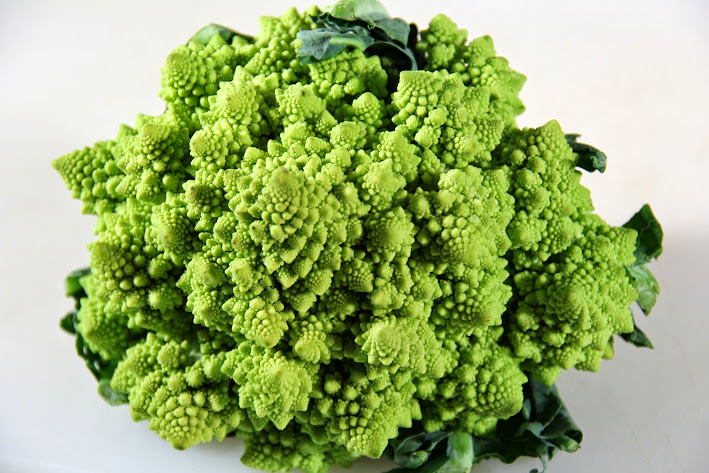
I am a firm believer that occasionally people should push themselves, jump off the high dive, try something new. Picking up a strange new ingredient at the supermarket may not be as drastic as starting a new career, none the less it expands ones universe. In the past year I have been noticing a gorgeous item in the produce section at my local grocery stores, this item which is beautiful in design is the Romanesco or Romanesque cauliflower. A plant which is closely related to both cauliflower and broccoli, Romanesco is strikingly unique in its almost fractal-like appearance.
A fractal is a geometric design which is is rooted in the principle of self-symmetry, or in other words a shape is made of smaller versions of itself (Frame), The Sierpinski Triangle is a great example of a fractal if the concept is still a little fuzzy. While Romanesco is fractal-like to the naked eye, it is not considered an actual fractal, once examined under a microscope its unique geometric similarity dissipates.
At this point you may be saying to yourself, "well it looks cool, but why should I eat it?" Romanesco is both a delicious alternative to veggies in the brassica family (Mustard, Cabbage, Broccoli, ect) and a food relic of the old Roman marketplaces, dating back to the days of Julius Ceaser (DePalama). Besides holding the admiration of the Italian people for thousands of years, it's really quite tasty. Romanesco has a more mild taste than common broccoli, and I find that it's delicious in both cooked and raw forms.
Other cherished elements of Italian culinary traditions, balsamic vinegar and red wine are the majority components of this salad's sweet and tart salad dressing. Because I used conventional and there for much affordable balsamic vinegar, I used a technique called reduction in order to achieve a denser consistency. Reduction is simply when a liquid with a high sugar content is boiled until enough water evaporates leaving the rest of the liquid as a syrup. Conventional balsamic vinegar is now common in all supermarkets, which is excellent for a variety of purposes. However, if you are unfamiliar with real balsamic vinegar, this excerpt from Versitile Vinegar does an excellent job explaining what actually makes a balsamic vinegar.
Traditional Balsamic Vinegar of Modena must be produced within the town of Modena in Italy. It was granted a protected designation of origin (PDO) by the European Union in 2000 (Council Regulation (EC) No 813/2000, April 17, 2000).
“Aceto Balsamico Tradizionale di Modena” is made from white and sugary Trebbiano grapes grown on the hills around Modena. Custom demands that the grapes are harvested as late as possible to take advantage of the warmth that nature provides there. This traditional vinegar is made from the cooked grape "must" and is aged for a minimum of 12 years or 25 years (denoted by the label claim “extra aged”). The aging process occurs inside barrels of successively smaller size of different kinds of wood, such as juniper, chesnut, mulberry and oak.
All of the product that is bottled must pass a sensory examination run by a panel of five tasting judges. The Italian Ministry of Agriculture in 2009 designated Consorzio Tutela ABTM (Consortium for Protection of Traditional Balsamic Vinegar of Modena) to run controls and to supervise manufacturing, as well as to promote the product at the institutional level. The Consortium has over 300 members.
Traditional Balsamic Vinegar of Modena is only bottled in the distinct bulb-shaped glass bottle of 100 ml (3.4 ounces). Traditional Balsamic Vinegar of Modena is dark brown, but full of warm light. It is exceptionally sweet and thick, with a rich, complex aroma with light acidity. It is generally found in specialty stores.
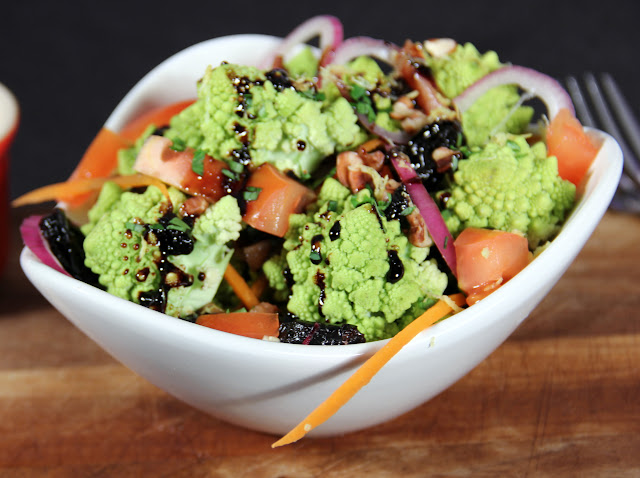
Fractal Salad
Ingredients

- 1 Head of romanesco
- 1 Red onion
- 1 Ripe tomato
- 1 Large carrot
- 1/4 c walnuts, toasted
- 1/2 c Dried cherries (raisins are an acceptable substitution)
- Lemon zest
- Parsley, picked
- Construct a salad with all these components, play around with shapes, colors, and layering.
Red Wine Balsamic Reduction
Ingredients
- 1/2 c Dry red wine
- 1/2 c Balsamic vinegar
- 2 t Sugar
- 1 t Ginger, grated
- Add all ingredients to a small pot and put heat on medium high
- Reduce until reduction can coat the back of a spoon and stick. Refrigerate and serve ontop of salad once cool.
Frame, Michael, Benoit Mandelbrot, and Nial Neger. "Fractal Geometry." Yale, n.d. Web. 23 Feb. 2015. <http://classes.yale.edu/fractals/>. DePalma, Gina. "Seriously Italian: Broccoli Romanesco." Serious Eats. N.p., n.d. Web. 23 Feb. 2015. <http://www.seriouseats.com/recipes/2009/10/seriously-italian-broccoli-romanesco-recipes.html>. - "Today's Vinegar." versitilevinegar. The Vinegar Institute, n.d. Web. 23 Feb. 2015. <http://www.versatilevinegar.org/todaysvinegar.html>.
 Who doesn’t love great street food? Essentially street food is cheap, simple, and carries bold savory flavors. Throughout Mexico, the Southern United States, and cities with big Mexican populations, Elote is a summer favorite. “The fresh cob of Zea mays is called ‘elote’ in Spanish, when the kernels are soft and milky; once fully matured and dried, the kernels are called ‘maiz.’ In Yucatan, several distinct varieties can be found, varying in the size of the cob (which ranges anywhere from 3 to 8in./ 8-20 cm in length), the number of rows of kernels, the time to reach maturity, not to mention the color of the kernels; yellow, white, red, and blue.” (Sterling, 31)


