Showing posts with label Duck. Show all posts
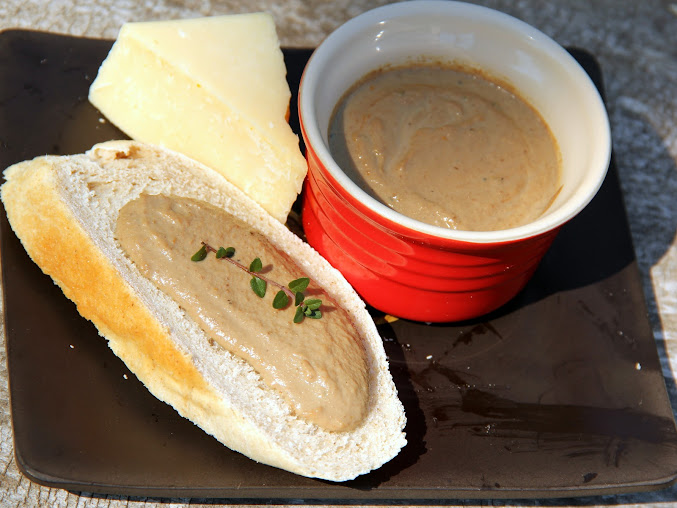
Honey Duck Liver Pate Don't fear it! Liver and other undesired parts of meat animals can be tasty, nutritious, and affordable. I consider one of the largest shames of the the modern food industry is the total disconnect consumers have with their meat. Why is a breast an acceptable muscle to eat with no regard, and a heart is repulsive? If you have an answer to this let me know, because I do not.

Modern-day conveniences of giant grocers provide meat which comes cleaned and packaged to such a degree one might forget that the meat once belonged to living and breathing animals. So in respect to food sources I urge you to look into the 'other meat' known as offal. Kidney's, heart, neck, and of course liver may have a bad reputation in the United States, but these are important culinary elements in other areas of the world, and in respect to using whole animals provide their own set of challenges and delights.

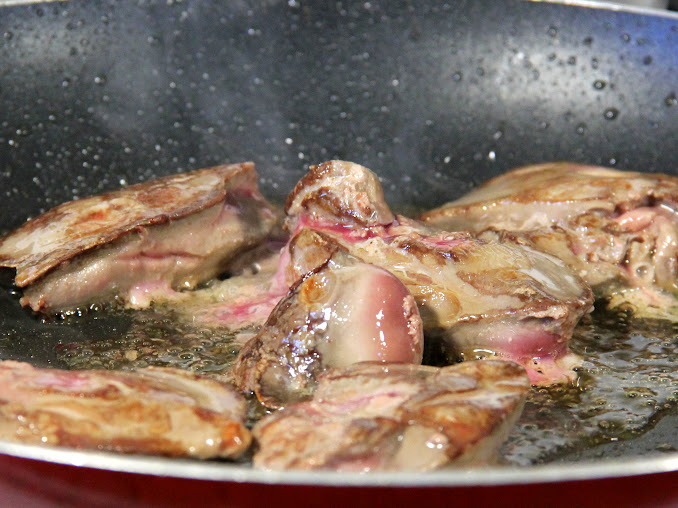
One of the easiest ways I can think of to transform offal is by making a pate. Pate literally translates to paste in French, and this paste-like texture is really the only thing pate's across the world have in common. It's true, despite the misconception that the French foie gras pate is the epitome of gourmet snacks, pate exists in many different forms across the world. In Charcuterie Michael Ruhlman and Brian Polcyn describe pates generally as an emulsion of meat(not always though) and fat, however a pate does not technically need to be an emulsion. (202) There is no steadfast rule to pates, and in my opinion this freedom to explore is incredibly exciting.

Liver is actually a heavily nutritious organ. Duck liver alone is high in the minerals iron, copper, and selenium as well proteins and beneficial vitamins. This is due to the liver's function in the body, livers help with digestion, metabolism, detoxification, and stores many of the bodies reserve of minerals(Taylor). The reserves of minerals in the liver makes it a nutrition powerhouse for humans, however if cooked incorrectly it may contain an unpleasant metallic taste.

There are several ways to reduce the metallic taste liver may have, but the easiest for this pate's purpose is to not overcook the liver. Don't be scared by a little pink in your meat or offal! The honey, white wine, and thyme are subtle but bring the paste to life. Please share other food recipes for liver with me via my e-mail or in the comments below.

Honey Duck Liver Pate

Honey Duck Liver Pate


Ingredients
  • 1/2 pound Duck livers
  • 2 T Dry white wine
  • 2 T Duck fat, and extra to cook livers with
  • 1 T High quality honey
  • 1 Shallot
  • 1 T Whole milk
  • 1/4 t Thyme, minced
  • 1/4 t Orange zest
  • salt and pepper to taste
Cooking Directions
  1. Remove the sinew from all livers.
  2. Dry liver with a paper towel, while drying heat a pan with duck fat over medium high heat.
  3. Once hot, add the livers and brown on both sides, cook the livers to medium doneness.
  4. Remove the livers from the pan and let rest, add minced shallot and let them brown in the same pan which cooked the liver.
  5. Once browned, deglaze the pan with white wine and quickly scrape any residual fond.
  6. Combine livers and the shallot wine mixture to a food processor, add 2 T of duck fat, 1 T of milk and 1 T of honey and combine.
  7. place the mixture in a strainer and press on the back with a ladle or serving spoon.
  8. Add the thyme and zest and seasonings and spoon into ramekin's, once at room temperature transfer to a refrigerator and enjoy cool with bread. Consume within 7 days.
Total Time: 15 minutes

Citations and Further Readings:
  • Ruhlman, Michael, and Brian Polcyn. Charcuterie: The craft of salting, smoking, and curing. WW Norton & Company, 2005.
  • Taylor, Tim. "Liver." Inner Body. N.p., n.d. Web.
Braised Duck Thigh in a Savory Citrus Pancake

Okay, I'll be the first to admit this recipe is pretty time consuming and highly involving, but I intended to prove that with a little bit of creativity and know how, that anyone can make a delicious dish out of scrap pieces of meat or produce. The story goes like this, I had just broken down a whole duck and used every part of the animal except for the thighs. How often have you seen duck thighs for sale at the supermarket? Exactly, I wanted to put this meat to use despite there not being much. So i devised this dish in order to be a fun interpretation on a French classic.

French haute cuisine also known as high cuisine is often considered the epitome and backbone of Western cooking. This style of cuisine was popularized throughout the west in the mid 20th century but has it's modern roots at the end of the 18th century. Right after the French revolution, chef's like Grimod de La Reyniere and Jean-Anthelme Billat-Savarin, who were trained in per-revolution France, wanted to bring the traditions of French haute cusine and mix them with the values of the new ruling class.(Freedman, 265-266) Pre-revolution France was a time where great opulence in the form of outrageous feasts were held by a small portion of the ultra wealthy. The rich known for their greed were overthrown, and the result was a shocking event to the evolution of French cuisine. Post-revolution France experienced haute traditions being incorporated into the greater population, Brillat-Savarin said, "We have begun to separate gourmandise from gluttony and greed; it has come to be regarded as a penchant that one can enjoy... gourmets are placed alongside all others who have a particular object of predilection"(Freedman).

Duck A'lroange which is simply roasted duck with an orange sauce is a classical French dish by way of Florence, Italy (Young). The dish became popular throughout Europe and the U.S. after World War II, particularly gaining popularity in the 1960's in the U.S. (Anderson, 136). My recipe diverges from tradition, instead of roasting the duck, I braised it in a dutch oven. The braising process does not give the duck the same crispy skin as roasting would, but I was able to achieve a similar maillard reaction also known as the browning effect, while slowly cooking the thighs in the duck's own stock. The result is a tender and rich meat.

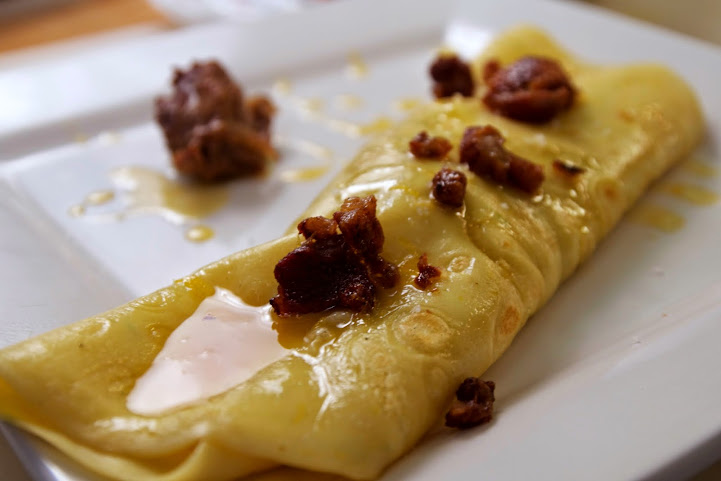
I wanted to serve this in a crepe, but slightly thicker. The batter I created is technically a pancake, but is not so similar to a flapjack. The savory pancake in this recipe is more like a denser crepe.

The orange based sauce that is drizzled on at the end is known as a coulis. While fruit and vegetables coulis are now common, this was not always the case. Coulis was originally the basis of all brown sauces in French cuisine. Various meats would be soaked in court bullion to create a rich meaty sauce. (Peterson 12) Thankfully, this coulis is acidic and sweet, which provides a nice contrast for the savory pancake and braised duck.

I always suggest buying a whole duck, chicken, turkey, etc and using all parts of the animal. I believe this to be a more thoughtful and respectful practice than relying on a supermarkets pre-cut meat options. Instead of paying a premium for convience, why not utalize the breasts, leg quarters, and wings for seperate meals, save the back and wingtips for a stock, and rendering the fat to use as a delicious replacement for cooking oils. Try to remind yourself that the animal you are consuming was once a living and breathing life form, their sacrifice should not go to waste.
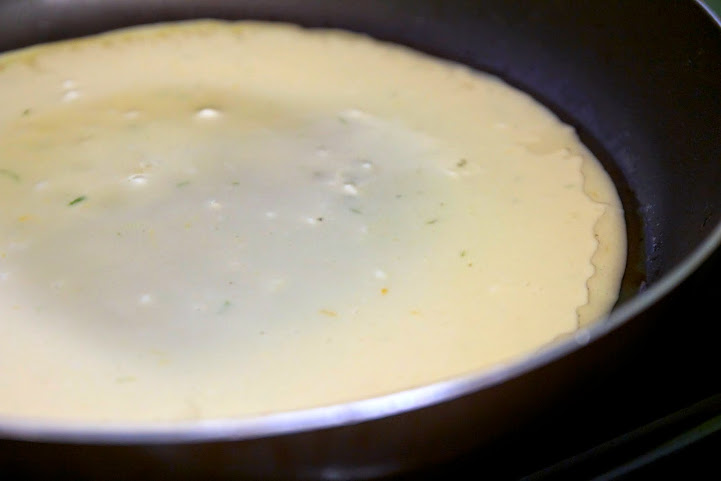
Pancake Cookin'

Braised Duck Thigh in a Savory Citrus Pancake w/ Orange Coulis


Duck Stock Braised Duck Thighs

Ingredients
  • 1 pound Duck thighs, trimmed and boned
  • 1/2 Red onion, small diced
  • 4 Garlic cloves
  • 2-3 c Duck stock (chicken stock may be substituted)
  • 1 bay leaf
  • 3 T Fresh parsley, chopped
Cooking Directions
  1. Preheat oven to 300 F.
  2. Heat 2 T of duck fat or vegetable oil in a Dutch oven over medium high heat on the stove top. Small dice ½ a red onion and 4 cloves of garlic, add to the Dutch oven. Cook until onions and garlic become translucent or approximately 3-5 minutes.
  3. Transfer onions and garlic into a separate container and deglaze Dutch oven with duck stock. Deglaze by scraping all the brown bits on the bottom of the Dutch oven with a wooden spoon after introducing the stock. Once deglazed, transfer the duck stock back into the bowl containing onions and garlic and reserve.
  4. Remove the skin of two duck thighs and reserve in a separate container. De-bone the two thighbones and cartilage in each thigh. At this point, it is fine if the meat is not looking pretty or even intact.
  5. Add 2 T of Duck Fat or vegetable oil to the Dutch oven and turn the heat on high.
  6. Pat dry the skinless duck thighs with a paper towel. Add kosher salt and black pepper to the duck thighs and throw them in the hot Dutch oven. Make sure to brown all sides.
  7. Remove the thighs and place on a plate once the thighs are thoroughly browned on the outside. Dump the duck stock, onion, and garlic mixture back into the Dutch oven and scrape off all the brown bits like before. Transfer the thighs back into the Dutch oven with the stock mixture. Add a dry bay leaf and fresh parsley to Dutch oven. Place a tight fitting lid over the Dutch oven and place in a middle rack of the oven for 90 minutes.
  8. Now start preparing the pancake batter.
  9. When braise is complete, remove the lid of the Dutch oven before cooking off the pancakes.


Savory Citrus Pancake

Ingredients
  • 1/2 c Duck stock (chicken stock may be substituted)
  • 1/2 c Whole milk
  • 1 c Eggs
  • 1 c All-purpose flour
  • 1 t Sugar
  • 1/4 t Lime zest
  • 1/2 t Lemon zest
  • a pinch of Kosher salt
Cooking Directions
  1. Combine 1/2 C duck stock and 1/2 C whole milk in one container.
  2. In a large metal bowl whisk 1 C eggs and 1 C flour together. Add the duck stock milk mixture slowly and continue to whisk.
  3. Add 3/4 t combined zest, 1 t sugar, and pinch of salt into the mixture. Continue to whisk.
  4. Cover the bowl with cling wrap and let rest in the refrigerator until you are ready to plate the dish or at least 1 hour.
  5. Put a stick-less pan over medium heat with 1-2 t of duck fat or cooking oil of your choice.
  6. Right before serving, spoon pancake batter over the pan on medium high heat. The pancake should be as thin as possible. Cook both sides until perfectly golden with brown spots.

Orange Coulis

Ingredients
  • 1 c Orange juice
  • 2 T Orange zest
  • 4 T Sugar
  • 1/2 t Kosher salt
  • 1 T Unsalted butter
Cooking Directions
  1. Combine orange juice, zest, and sugar in a small pot. Turn heat on medium high until the mixture gently boils down and reduces to a syrup-like consistency. Try to have the syrup coat the back of a wooden spoon.
  2. Take the syrup off the stove and whisk in 1 T of butter.

Crispy Duck Cracklin' Crumbs

Ingredients
  • Reserved Duck thigh or other duck skin
Cooking Directions
  1. Cut the reserved duck skin into several smaller pieces, thus they render and fry faster.
  2. Put all the skin into a small cast iron pan over medium low heat and render the fat out. The byproduct will be leftover duck fat, which can be saved for later.
  3. Once all the skin is golden brown remove to a plate lined with paper towels to absorb the fat.
  4. Transfer the skin to a cutting board and chop into bits, which will be sprinkled over the final dish
Total Time: 2 hours

Citations and Further Readings:
  • Anderson, Jean. The American Century Cookbook: The Most Popular Recipes of the 20th Century. New York: Clarkson Potter, 1997. 136. Print.
  • Freedman, Paul, ed. Food: The History of Taste. Los Angeles: University of California Press, 2007. 265-66. Print.
  • Peterson, James. Sauce: Classical and Contemporary Sauce Making. 2ndnd ed. N.p.: John Wiley and Sons, 1998. 12. Print.
  • Young, Elizabeth. "Duck all'arancia: The Florentine origins of a French classic." The Florentine 22 Nov. 2012. Web. 17 Dec. 2014. <http://www.theflorentine.net/articles/article-view.asp?issuetocId=8118>.
Photo's by Jordan Henline

Duck Fat Cherry Vanilla Creme Brulee

To a normal human being, dessert is not usually the first thing that comes to mind when one says 'duck fat'. But why not? It is rich and savory, substituting duck fat for butter or cream just makes sense. Granted I would put duck fat in everything if I had an endless supply!

Crème brûlée may seem like a dessert only available in the fanciest of restaurants, but it's actually a pretty simple dessert. Crème brûlée is one of several variations of crème anglaise, which is an indispensable pastry custard known as simple vanilla sauce. Crème anglaise is milk, cream or a combination which is sweetened with sugar, flavored with vanilla, and thickened by egg yolk (Ruhlman 211). Crème brûlée can be made with almost all common pantry ingredients, and it has been for centuries.

The first recipe for crème brûlée appeared in a cookbook by François Massialot called Le Cuisinier Royal et Bourgeois in 1691 C.E. (Muusers). Massialot produced a similar product to a modern crème brûlée but without the modern equipment available to the everyday cook. Massialot used a red hot shovel as a salamander, fresh out of a fire to caramelize the sugar on top of his crème brûlée. We are lucky enough to be well equipped with ovens, broilers, and over 300 years of human trial and error. That means there is no excuse not to create delicious crème brûlée in our homes whenever we please.

My version of crème brûlée contains a personally important triad of flavors. To me duck fat, dark cherry, and vanilla bean represent the feeling of warmth during the winter months. In fact, vanilla in particular has a strong psychological effect with regards to both flavor in scent. Vanilla's scent has been proven to reduce stress and anxiety in humans, "Cancer patients undergoing Magnetic Resonance Imaging - a diagnostic procedure known to be stressful - reported a massive 63% less anxiety when heliotropin (a vanilla fragrance) was administered during the procedure" (Fox 9).

I am uncertain if the pairing of cherry and vanilla is inherently coveted by humans or youthful nostalgia makes it so enticing. Bright red cherries stacked on top of scoops of vanilla ice cream bring back simple yet happy memories for many adults. Cherry and vanilla can be so much more though! The cherry balances out the duck fat and vanilla in this dessert to create a sense of harmony. I find it this convection contradictory, both experimental yet traditional. However, I'd take a contradictory yet delicious dessert over a consonant and dull last course any day.

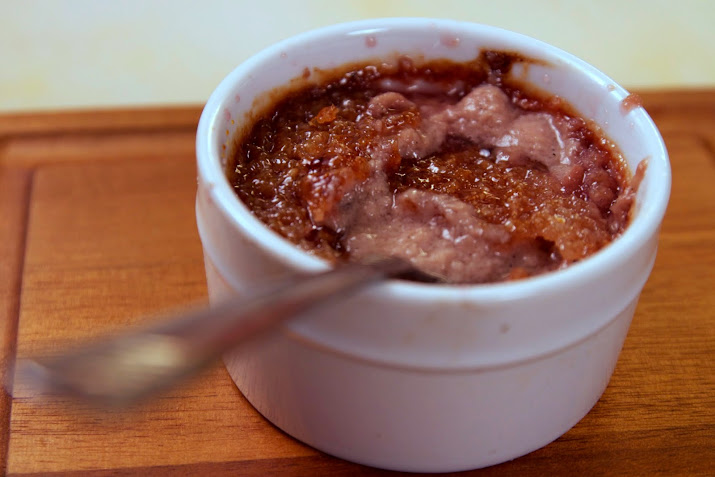
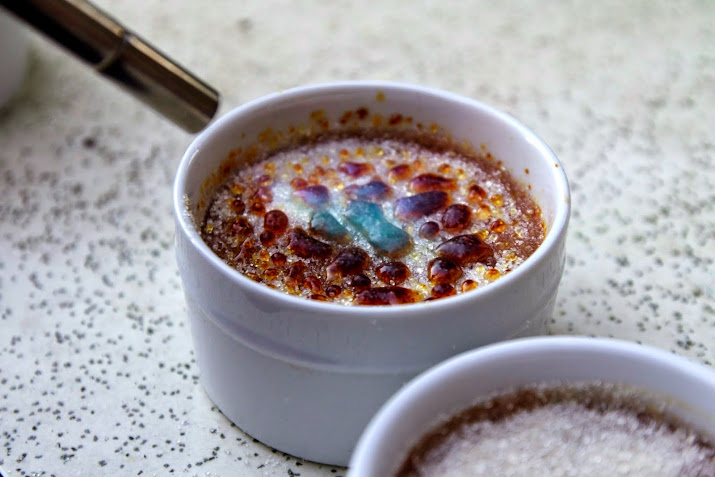
Caramelize the Crust


Duck Fat Cherry Crème Brûlée

Ingredients
  • 1 & 3/4 c 2% milk
  • 1/2 c Liquid duck fat
  • 1/2 c Frozen sweet cherries (preferably pitted)
  • 1/2 c Sugar
  • 1/2 c Egg yolks (6-7 yolks)
  • 1 Vanilla bean
  • 1 lime
  • pinch of salt
Cooking Directions
  1. Preheat oven to 325 F.
  2. Blend ½ C of pitted cherries in a food processor.
  3. Put the 1 & 3/4th C of 2% milk and pureed cherries in a small pot, set on medium heat. Scald the milk by heating until the mixture reaches 180 F. Once the milk reaches this point take off heat immediately, set aside covered for 15 minutes.
  4. Now pour ½ C of egg yolks, ½ C of sugar, the scraped insides of the vanilla pod, and a pinch of salt into a separate metal bowl. Place the leftover vanilla pod in the resting pot containing the milk. Whisk the egg/sugar mixture until thoroughly combined.
  5. After the milk mixture has sat for 15 minutes, slowly pour through a strainer into the egg yolks. The milk may still be warm, thus temper the egg mixture by pouring a little milk then whisking. Repeat this process several times before incorporating the milk mixture into the eggs.
  6. Take the room temperature ½ C of liquid duck fat and pour as slowly as possible into the egg/milk mixture. Try to keep the stream as thin as a pen head or smaller while pouring. Vigorously mix to incorporate the duck fat into the liquid.
  7. Set up a double boiler by bringing a pot of water to a boil that is small enough to place your metal bowl on top of. Let the Metal bowl sit for 3-5 minutes while slowly stirring. The mixture should thicken up enough to coat the back of a wooden spoon.
  8. Once the mixture achieves a thickened consistency carefully pour into 6 separate 4 ounce and oven safe ramekins.
  9. Carefully place ramekins into a deep hotel pan and make sure there is plenty of space between ramekins. If you don’t have a hotel pan any deep oven-safe dish is fine.
  10. Pour water into the hotel pan, thus the water comes about ½ - 2/3 of the way up the sides of the ramekins. Be careful not to submerge any of the custard in water.
  11. Slowly place the water bath into the preheated oven for roughly 40-45 minutes or until the custard is set. The custard is set when there is a slight jiggle in the center, but it is no longer liquid. The best way to get perfect set custard is to check at around 35 minutes and then check often afterwards.
  12. Carefully remove the crème brûlée from the oven, and then remove from the water bath. Transfer all ramekins to the refrigerator for 90 minutes.
  13. When ready to serve sprinkle enough brown sugar to lightly coat the top of the custard. For best results use a crème brûlée torch to caramelize the sugar until the heat forms a perfect shell. If that is not available place the ramekins under a high heated broiler and watch as the sugar caramelizes.
  14. To finish the dish lightly sprinkle lime zest over the top of the caramelized shell.
Total Time: 3 Hours

Citations and Further Readings:
  • Fox, Kate. "The Smell Report." Social Issues Research Center. SIRC, n.d. Web. 18 Nov. 2014.
  • Muusers, Christianne. "Crème Brûlée." Coquinaria. N.p., 20 Feb. 2005. Web. 18 Nov. 2014.
  • Ruhlman, Michael. Ratio. New York: Scribner, 2009. 211. Print.
Photos by Jordan Henline
Duck Breast Steamed Bun

Duck breast is special delicacy that deserves the respect and admiration of the meat eating world. This respect is critical because when duck breast is cooked improperly the meat is tough, the flavor can be gamey, and the skin is rubber-like. However, following a certain set of rules duck breast can be transformed into an amazing and complex animal protein. The breast becomes tender, the flavor is rich, and when duck skin is rendered in its own fat it becomes heavenly crispy.

Ducks are biologically designed to have different properties and flavors than the other commonly consumed poultry in America. Chicken and turkey largely differ from duck due to the duck's dark red meat. The duck's muscles have an abundance of myoglobin rich red muscle fibers, the dark red muscle tissues allow ducks to fly hundred of miles in a day with few stops (McGee 140). In addition to the delicious red meat, the duck's valuable and delicious fat provides a store of energy for these long flights. The excess of duck fat is what allows cooks to create a perfectly crispy skin when pan-searing.

Researchers at Cornell University have found that the popular breed of Pekin duck was domesticated in ancient China during the Yuan dynasty which lasted from 1271-1368 C.E. However, evidence exists that various cultures have been using ducks as food for at least 4,000 years(Dean). The Chinese and other rice growing Asian countries have been growing and depending on these ducks for centuries. In fact, in rural communities ducks can provide a "major source of income for one or more families." (Dean, Sandhu)

It was a logical step for me to honor this history by pairing a pan seared duck breast with an Asian steamed bun also known as bao. Bao are a Chinese innovation dating back to around 220 C.E. Chinese history tells of a military strategist named Zhuge Liang who created the steamed buns while on a military campaign in the South of China(Ye Jun). The popularity of the buns spread throughout China and now equivalents are found in Vietnamese, Mongolian, and other East Asian cuisines. The steamed doughs can be formed into breads, buns, or dumplings, but one thing remains the same about these buns. They have an extremely light and particularly fulfilling texture.

The buns are given their unique texture by using a combination of biological and physical leavening methods. First the dough is raised by yeast's released gasses as it proofs. Secondly, the steaming helps the dough surface reach 195F/90C quicker than dry cooking methods. The steam forms a film of water that prevents a crust and keeps the gluten network flexible which allows for greater expansion while cooking.(McGee 540)

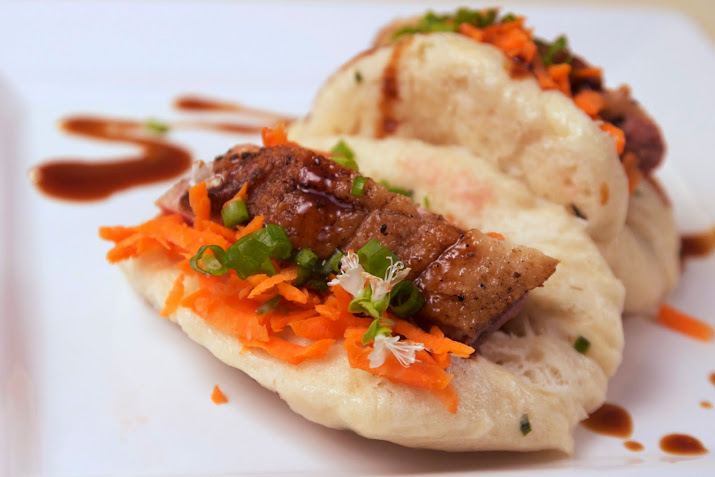
This dish contains several unique textural and flavor elements, but it would not be complete without a sauce. The dish is finished with a savory, salty, and mildly sweet sauce. Duck stock can be substituted with any stock available. Simply finish the dish with a shredded carrots, scallions, and fresh basil blossoms. Pan Seared Duck Breast Pan Seared Duck Breast in a Scallion Steamed Bun


Steamed Scallion Bun
2 t active dry yeast
2 & 1/8 c bread flour
3 T sugar
1 & 1/2 t kosher salt
1/4 t baking powder
1/4 t baking soda
1/6 c liquefied duck fat
1/4 sliced scallions

1. In a medium bowl stir together 2 t of active yeast and ¾ C of room temperature water approximately 80 F. Let this mixture rest for 1 minute.

2. In the same bowl add 2 C and 2 T of bread flour, 3 T of sugar, 1 and 1/2 t of kosher salt, 1/4th t baking powder, 1/4th t baking soda, 1/4th C of scallions, and 1/6th C of liquefied duck fat.
3. Mix ingredients by hand until a soft and slightly sticky ball of dough forms. This takes roughly 3-5 minutes. Then oil the ball of dough with either duck fat or vegetable oil.
4. Place the dough in a bowl. Cover the bowl with a damp towel and set the bowl aside, somewhere that is warm for 1 hour.
5. After an hour of proofing punch the dough down. Transfer the dough to a cutting board. Cut the dough into 4 separate pieces, and then divide each into 2 more equal pieces. There should be 8 large balls of dough after separating. Roll each of the balls by hand into uniform balls and place on a sheet pan or hotel pan. Cover the pan with cling wrap and let rise for another 30 minutes.
6. Cut out 16 pieces of 4” x 4” parchment paper to place the buns upon while steaming.
7. After 30 minutes roll each of the balls into circles with a rolling pin or by hand. Lightly coat both sides of the bun in either duck fat or vegetable oil.
8. Now take the 16 pieces of parchment paper and fold all of them diagonally to create a triangle. Place the dough in the center of an open piece of parchment paper. It should be in the shape of a square. Now place a folded triangle piece of parchment crease down on top of the dough. Fold the dough with parchment in half to create a bun. The goal of the parchment paper is to allow the buns to steam and not cling to the steamer pan on the outside or themselves while maintaining its shape.
9. Let the buns rest in their new shape, again covered for 30 more minutes.
10. Place buns with parchment paper attached into a steamer for 8-10 minutes.
11. Discard parchment before serving.

Pan Seared Duck
One large duck breast

1. Take the duck breast out of the refrigerator 50 minutes before you prepare to plate the meal. Let duck sit out for 20 minute to come to room temperature. The cooking and resting of the duck takes approximately 30 minutes in addition.
2. Before trimming the breast preheat the oven to 280 degrees.
3. Trim any access silverskin, pieces of bone, and hard connective tissue off the meat side of the duck breast.
4. Flip the breast over and gently cut crosshatch marks on the skin side of the duck breast. This will help render fat.
5. Right before getting ready to cook the duck breast sprinkle kosher salt and ground black pepper over both sides of the breast.
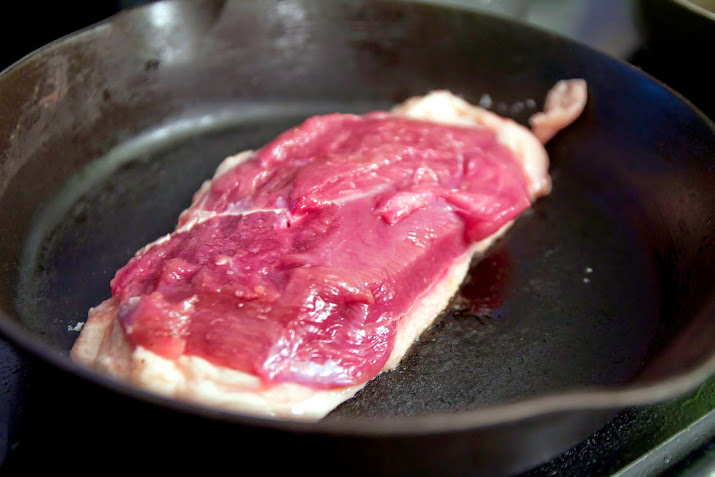
6. Place the breast skin side down in a small cast iron on a medium low heat and let fat render for roughly 12-15 minutes. The Goal is to have most of the fat melt out of the duck breast but achieve a crispy golden skin. You may occasionally need to spoon out excess duck fat that collects. You may reserve this fat for a future use.
7. After achieving the golden brown skin, flip and cook the meat side for about 3 minutes over medium heat.
8. Put the breast in 280 F oven for another 3-5 minutes.
9. The goal is to achieve a medium rare duck breast with an internal temperature of 130 F. The temperature will rise while the duck is resting of the oven, thus 130 F is perfect.
10. Let the breast rest for 10 minutes, and at this point you will want to put the buns in the steamer.
11. After placing buns in the steamer, grate a carrot and thinly slice 3 green onions. Set aside to top the buns with while plating.
12. Slice the breast diagonally in 8 pieces, try to make them as even as possible.
13. To finish the dish simply place the duck breast inside a steamed bun with the crispy skin on top. Top with shredded carrots, green onions, and a drizzle of the savory duck sauce. Place several basil blossoms over the sauce.

Savory Duck Sauce
1 c duck stock (substitute with chicken stock if duck stock not available)
1/4 c hoisin sauce
2 T regular soy sauce

1. Stir 1 C of duck stock, 2 T of soy sauce and 1/4 C of Hoisin in a small pot and whisk.
2. Bring the heat to medium high and let the sauce reduce.
3. Once the sauce can coat the back of a wooden spoon, take off heat and reserve until ready to serve.

Yield: 8 Buns
Total Time: 2 Hours 45 Minutes

Citations and Further Readings:


  • Dean, William F. "Food Value of Duck." Duck Research Labratory. Cornell University, n.d. Web. 15 Nov. 2014. <http://www.duckhealth.com/foodvalu.html>
  • Dean, William F., and Tirath S. Sandhu. "Domestic Ducks." Duck Research Labratory. Cornell University, n.d. Web. 15 Nov. 2014. <http://www.duckhealth.com/dmstduck.html>.
  • Jun, Ye. "Best of Buns." Beijing Weekend. China Daily, 21 May 2004. Web. 15 Nov. 2014. <http://www.chinadaily.com.cn/english/doc/2004-05/21/content_332721.htm>.
  • McGee, Harold. On Food and Cooking. New York: Scriner, 2004. 140, 540. Print.
Photos by Jordan Henline