Showing posts with label Fruit. Show all posts


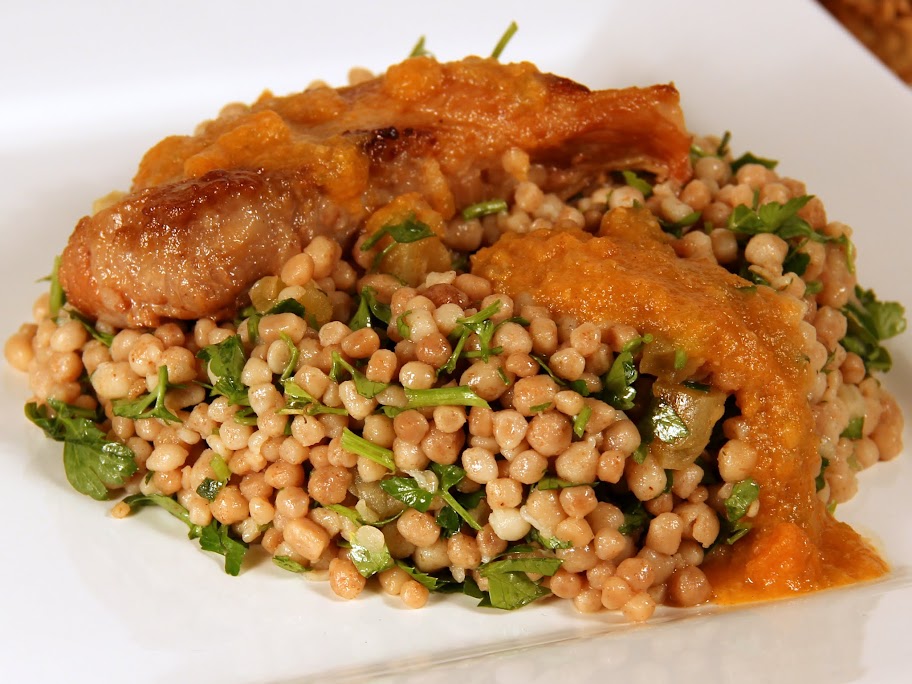
Braised Pork Jowl with Persimmon Gravy
Pork jowl, also known as pork cheek is one of my favorite cuts of pork. When jowl is braised over a long period the meat becomes "melt in your mouth" tender. Pork cheek is both chock full of fat and collagen, so it needs to be cooked low and slow for best results. Think of past experiences with cuts of meat like oxtail, ham hock, and shoulder.

Pork cheek is popular across the world, I have seen it atop a bowl of ramen as Chashu, cooked in a Sichuan style, and cured as the Italian Guanciale. Pork cheek shares many similarities with pork belly, and I have found that it is a wonderful substitution in many cases. One of the best arguments I can make about using pork cheek is the comparable cost per pound. As pork belly has risen in popularity, so has its price. Pork cheek is less expensive than pork belly, I bought mine from a higher priced butcher store and still paid under 5 dollars for a pound.

This dish may appear somewhat exotic, but it was meant to be a homey dish to enjoy during the cold winter months. Stews, soups, and other braises are perfect for this time of year and perfume homes with their irresistible scents. Like many braises, this dish will take over three hours to prepare, so I suggest planning ahead, embracing the smells, and enjoy the lengthy process.


Braised Pork Jowl with Persimmon Gravy

Ingredients

  • 2 Fuya persimmons
  • 2 c White wine
  • 1 pound Pork cheek
  • 4 Garlic cloves
  • 2 Red shallots
  • 1 Stalk of celery
  • 1 T sugar
  •  
    Cooking Directions
    1. Trim the fat off of 1/2 to 1 pound of pork cheek until the majority of its fat is removed, then salt.
    2. Heat up an enamel coated dutch oven or another pan with plenty of high heat oil.
    3. Brown all sides of the pork cheek and set aside discard leftover oil.
    4. Add roughly 1 T of butter into the Dutch oven or whatever pan you are using and over medium heat brown shallots, celery, and garlic.
    5. Once browned, deglaze with 2 c of dry white wine, scrape the residual fond.
    6. Place the browned pork cheek back in with the wine mixture, and add two skinless Fuyu persimmons.
    7. Cover Dutch oven with a tight-fitting lid and cook in a 250F oven for 3 hours, if you are not using a Dutch oven, transfer everything to a lidded oven safe pot or other braising cookware.
    8. Once again remove the pork cheeks from the Dutch oven and set aside.
    9. Transfer the braising liquid into a blender and blend until smooth, transfer back to the Dutch oven. Add 1 T of sugar and adjust seasonings if necessary, and reduce on the stove top over medium-high heat. 
    10. Once thickened to a gravy-like consistency remove from the heat.
    11. Serve pork cheek with a side dish(es), and top with persimmon gravy.
    Total Time: 3 Hours 30 min

    Preserved Lemons over Salad

    Having a well-stocked pantry and fridge can make or break the home cooking experience. Staple condiments provide comfort, and may bring sweetness, saltiness, sourness, brightness, or spiciness to an otherwise bland meal. Today's recipe is a pantry staple all over the world, and for good reason. Preserved lemons are easy to make and stretch the beloved lemon throughout the months which they are out of season.

    The origins of preserved lemons date back to at least Roman times, but likely much earlier (Soyer, 110). They can be found in cuisines in the geographic span of Morocco to India. (Sonneman, 34) I most commonly associate the pickled citrus with North African stews and Moroccan tagine. North African food is vibrant with bold spices and colors; that is why ingredients like preserved lemons should be in every self-respecting home cook's repertoire.

    So today we start preserving lemons! The unique fragrance of preserved lemons will add a distinct brightness to home cooked North African, Middle Eastern, or South East Asian dishes. Besides lemons, another citrus may be used in this pickling method. Limes, Grapefruit, and even oranges can be salted, cured, and allowed to ferment in their juices to extend their lifespan. Just like other pickles, spices may be added to preserved citrus to alter the flavor.


    Preserved Lemons

    Ingredients

    • Your preference Lemons
    • Box Coarse Kosher salt
    • Your preference Mason Jars
    Cooking Directions
    1. Clean Mason jar(s), and allow to dry.
    2. Pour roughly 1 T of salt, or enough to create a layer into the bottom of the dry jar(s).
    3. Cut the tops off of all lemons, and quarter without cutting all the way through.
    4. Add a large pinch of salt in the center of the cut lemon and rub.
    5. Press down and allow some juice to come out. Give the jar a good shake and place in a dark area like a cupboard or drawer away from direct sunlight.
    6. After three days, remove and with a wooden spoon or other long-handled tool press the lemons to release the rest of their juices. If the leftover juice does not fully submerge, the lemons add fresh lemon juice on top.
    7. Place back in the same spot and allow the preserved lemons to ferment for one month.
    8. The preserved lemon rind also known as peel will be good to use indefinitely. Refrigerate and enjoy as needed.
    Total Time: 1 month+

    Citations and Further Readings:

    • Sonneman, Toby. Lemon: A Global History. London: Reaktion Books Ltd, 2012. Print.
    • Soyer, Alexis. The pantropheon, or, History of food, and it's preparation: From the Earliest Ages of the World. Boston: Ticknor, Reed, and Fields, 1853. Print. 
        Potato and Carrot Latke

        The total freedom of experimentation while writing Joy and Feast articles is extremely gratifying. Sometimes my experiments come from what produce I can source fresh, other times I find inspiration from a myriad of books or articles that cross my table. Sometimes I am able to explore food which has a significant meaning to me. Latkes or potato pancakes are a food that I have been acquainted with my entire life, I have wanted to write an article about them since I began this blog.

        Potato pancakes are consumed during the Jewish holiday of Hanukkah, this is actually a fairly recent tradition. Jews, particularly in Western Europe have been consuming fried cheese pancakes for Hanukkah since the late middle ages. It was not until the mid-1800's when a series of crop failures in Ukraine and Poland forced farmers to plant potatoes, a nightshade crop from the new world. Perhaps this abundance of potatoes influenced the adoption of potatoes in place of cheese pancakes during this period. Potato latkes have remained prominent ever since. (Avey) Fried potato pancakes span well beyond Jewish culture, potato pancakes are regularly enjoyed throughout Central and Eastern Europe, as well as in the Middle East.

        Often "traditions" or in this case traditional foods are confined to a dogmatic perception of culture, when in reality culture is fluid. Culture reacts to influences both internally and externally. Modernity has allowed cooks access to more information, ingredients, and communication than at any other point in human history. Lines have always been blurred, and we will continue down this path. Therefore, I believe that looking at one cultures "traditional food" through the lens of another culture can inspire some pretty creative and delicious meals.

        The lens that I envisioned today's recipe through took influence from India's great culinary tradition. Firstly, it is worth noting that the nation of 1.2 billion people (World Bank) has different cultural and food traditions depending on region within the country. India has influenced and been influenced by far flung cultures and empires for millenniums. The silk road encouraged the trade of spices in which eastern and western cultures passed through India and left their mark. In addition, India contains tropical (wet and dry), sub-tropical, and mountain climates allowing for a diverse spectrum of agrarian potential.

        What I love about Indian flavors is how the cuisine embraces pungency, spiciness, and boldness. A basic fresh apple puree, can become addictive with the right use of Indian spices. Garlic, ginger, and chili is a common trinity throughout tropical latitudes. Bold Indian flavors with Potato latkes make an unforgettable dish.
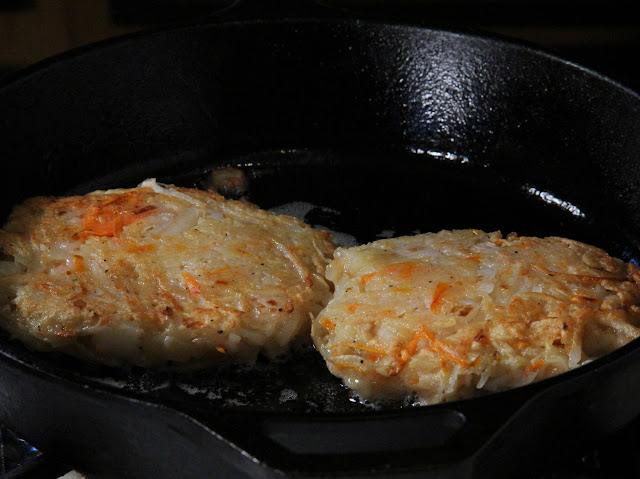
        Potato and Carrot Latke
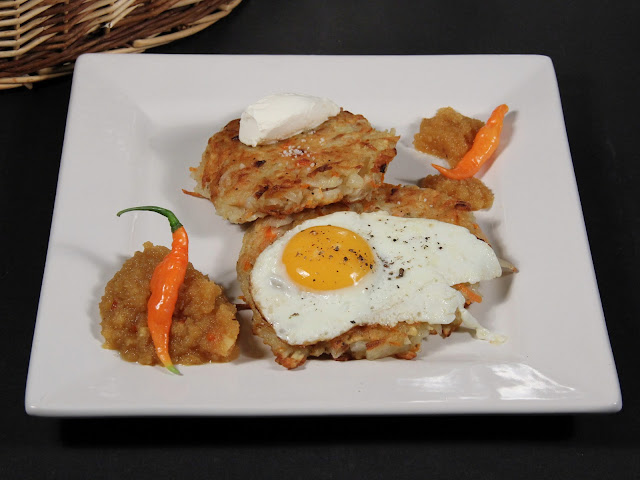
        Potato and Carrot Latkes with Indian Spiced Apple Sauce


        Potato and Carrot Latkes


        Ingredients
        • 6 Russet potatoes, peeled
        • 2 Large carrots, peeled
        • 1 White medium onion, diced
        • 2 Large eggs
        • 1 c All-purpose flour
        • to taste salt & pepper
        Cooking Directions
        1. Shred potatoes and carrots, I stored mine in acidulated water. That is water with about 1 t of lemon juice or vinegar. Omit this step if cooking latkes right away
        2. If stored in water make sure to thoroughly dry, extra moisture is bad for latkes
        3. Combine diced onion, shredded potatoes & carrots, eggs, and 1 c of flour into a mixing bowl. Season to taste.
        4. Heat up a pan over medium high heat with enough oil to cover the bottom.
        5. Patty out latkes and add them to pan once the oil sizzles when droplets of water touch, or over 350F. The thinner the latke, the easier it will be to cook through the center. Take care not to crowd the pan.
        6. When the latke starts to brown around the side, flip and cook until browned on the other side.
        7. When finished quickly pat dry with a paper towel to absorb excess oil, then place into a pan with a rack in a low temp oven while the rest of the batches of latkes finish.

        Indian Spiced Apple Sauce


        Ingredients
        • 4 Medium sized sweet apples, peeled and cored
        • 2 t Ginger, minced
        • 1 t Garlic, minced
        • 1-3 Chilies, sliced
        • 1/2 Lemon, juiced & zested
        • 1 Star anise
        • 1 Green cardamom pod
        • 5-8 Peppercorns
        • 1/4 t Brown mustard seed
        • 1/8 t Cumin seed
        • salt to taste
        Cooking Directions
        1. Start with 4 medium sized ripe and sweet apples. Peel, core, then puree and set aside.
        2. Toast star anise, cardamom pod, peppercorns, brown mustard seed, and cumin in a dry skillet over medium high heat, constantly toss. Once the mustard seeds start to pop take off heat.
        3. Make a sachet with the toasted spice mix.
        4. Add vegetable or coconut oil to a pan and brown ginger and garlic for about a minute over medium high heat. Add the chilies and cook for another minute, constantly tossing or stirring.
        5. Add the apple puree into the garlic, ginger, chili mixture, and add about 2 T of water. Reduce heat to medium low. Add satchet of spices and cook for roughly 15 minutes.
        6. If to much water evaporates add more until a proper consistency and the spices meld with the sauce.
        7. Zest lemon and squeeze juice directly into the mixture. Add salt to taste and let cool to room temperature. Toss sachet when finished.
        Total Time: 1 hour
        Citations and Further Readings:
        • Avey, Tori. "Discover the History of Latkes During Hanukkah." Food. PBS, 12 Dec. 2011. Web.
        • "The Commonly Used Indian Spices." eCurry. N.p., 24 Aug. 2008. Web. 24 Aug. 2015.
        • "Total Population (in number of people)." The World Bank. World Bank, n.d. Web.