Showing posts with label Breakfast. Show all posts
Pancake Bread Pudding

Unsustainable practices found in large scale food production, distribution, and commercialization are not primarily focused on nutrition, profit margins dictate our large scale food production and agriculture practices. There are many issues that I hope to address in future posts, but today I wanted to focus on food waste. Food waste is both a humanitarian and ecological issue, which neither mainstream journalism or politics has adequately addressed, yet almost every one of us is guilty of wasting food to varying scales. In fact, the USDA states that in 2010, 30-40% of the US food supply (about 133 billion pounds of food) were thrown out and never consumed. These numbers included retail food suppliers, restaurants, and home kitchens.

133 billion pounds of food per year is an incredible amount of food to sit in a landfill for the rest of eternity, considering that a large portion of it could go to feeding hungry people or be used in agriculture to feed animals or compost. I do not have a cure-all solution for our food waste problem, but I do think that through better management, storage methods, and creativity our nation can reduce food waste especially in the home sector. That is why I want you to take a moment and think about what food you have thrown out in the past week. What steps could you have taken to preserve and utilize that food?

This recipe came about after a Sunday pancake breakfast where I was faced with a wasteful dilemma of my own. There were plenty of leftover pancakes and despite a desire to trash the leftovers and be done with it, I started to brainstorm ways to re-purpose, and the result was a winning dessert. Bread pudding is a perfect way to save and re-purpose bread, or other dough/batter products, and it generally only requires staple pantry and refrigerator items.

Pancake Bread Pudding


Pancake and Blackberry Bread Pudding


Ingredients
  • 1 & 1/2 c Whole milk
  • 3 c Pancake scraps, torn
  • 2 Large eggs
  • 1 c Sugar
  • 1 T Vanilla extract
  • 2 Blackberries per pudding
  • 1/2 t Cinnamon
  • 1/4 t Ground sage
  • Butter to coat tin
Cooking Directions
  1. Coat cupcake tin with butter and preheat oven to 350 .
  2. Add milk and pancake scraps into a bowl and combine with hands.
  3. Mix eggs, sugar, vanilla extract, and spices in a separate bowl.
  4. Combine both bowl's contents and mix.
  5. Pour batter into cupcake tin.
  6. Stick 2 blackberries in each cupcake.
  7. Bake for 40 minutes or until set.
  8. Let sit for 10 minutes then remove and transfer to a wire rack.
Total Time: 1 hour
Citations and Further Readings:
  • "USDA and EPA Launch U.S. Food Waste Challenge Calls on both Public Sector and Private Industry to reduce food waste." www.USDA.gov. USDA, 4 June 2013. Web.
Baked Goose Egg and Red Pepper with Chorizo

This week's recipe was such a blast to develop and photograph. I was gifted three beautiful geese eggs from my friend. As a proponent of actual free range chicken eggs, these three geese eggs made the quality control cut. These geese have lived a happy life feeding on what nature provides, as well as produce scraps, a healthy diet generates richer and uniquely satisfying eggs. Eggs are marvels of nature, they are essentially maternal gifts of protection and nutrition to their offspring. Eggs provide birds, reptiles, amphibians, and fish with fats and proteins as well as other nutrients in order to develop into larger animals. With such a huge variety of eggs to take advantage of why do American's primarily only invest in chicken eggs, when there are delicious alternatives like geese eggs available? I believe that is a complex question with a variety of economic, agricultural, cultural, and environmental factors. However, if more Americans opened their minds to geese eggs as a food source, they would be in for a treat.

Geese, like chickens chickens will lay eggs regardless of fertilization. This means by not eating unfertilized geese eggs we are doing a disservice to ourselves, unfertilized geese eggs will eventually rot and completely go to waste if unused. Geese eggs are primarily considered a spring delicacy, there is only a fairly short window to enjoy the large eggs. In North America, geese primarily lay eggs from as early as mid-February to late May.(USDA, 1) In addition to the limited window for egg production, mother geese are notoriously aggressive for protecting their eggs, both fertilized and unfertilized. (Shoot) This is another big turnoff to potential egg producers, also known as farmers.

There are many wonderful applications for geese eggs including baking, poaching, cooking in a precise water bath, frying, pretty much any way you would use a chicken egg. There were countless options for recipe development, but I thought it would be fun to go in a mostly Spanish route. The inclusion of the the Spanish chorizo really helps elevate the dish and set it apart from your regular old bell pepper baked goose egg.

Spanish chorizo should not be replaced in this recipe with Mexican chorizo. Spanish chorizo is a hog casing stuffed, cured, fermented, and dried style of sausage, similar to pepperoni in technique. Mexican chorizo has different spices and is either free-formed ground pork or stuffed into a casing, but must be cooked. I will demonstrate different styles of sausages and techniques in future Joy and Feast posts, but for now I will only suggest to try finding the best Spanish chorizo available in your area. Pretty much any American charcuterie practitioner worth buying from will offers a Spanish style chorizo.
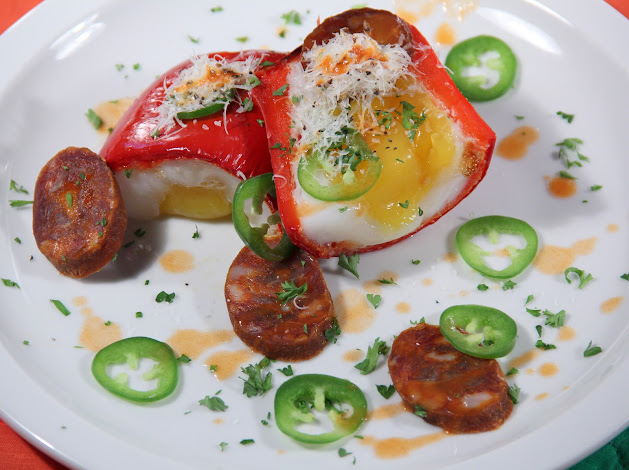
Baked Goose Egg and Red Pepper with Chorizo

Stuffed Bell Pepper with Baked Goose Egg, Spanish Chorizo, and Chilies

Ingredients
  • 1 Goose egg
  • 1 Large red bell pepper
  • Slices Premium Spanish chorizo
  • 1 Jalapeno, thinly sliced
  • Parsley, minced fine
  • Romano cheese (Parmesan), grated
  • Tabasco sauce
  • salt and pepper to taste
Cooking Directions
  1. Preheat oven to 350F
  2. Cut open the bell pepper and remove the seed pod, any remaining seeds, and the leftover white membrane.
  3. Rub the outside skin of the bell pepper with olive oil or organic canola oil.
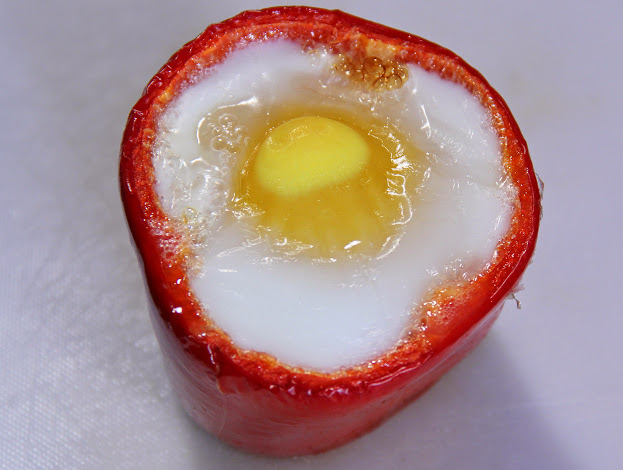
  4. Gently crack the goose egg and fill the bell pepper cavity.
  5. Place the egg-filled pepper in a cast iron pan or an oven proof dish, then bake between 35-50 minutes. The duration of cooking will depend on several factors including egg size and elevation, check at 35 minutes and remove when it is done. Remove the pan when the egg white and yolk are completely set.
  6. Slice the egg filled pepper in half with a very sharp knife.
  7. Plate the pepper and dress with chorizo, jalapeno, parsley, Tabasco, salt, pepper, and Romano cheese on top. The quantities should suite your needs, an omission of chorizo makes this dish vegetarian.
Total Time: 1 hour
Citations and Further Readings:
  • "Canada Goose." Wildlife Services. USDA, Aug. 2009. Web. <http://www.aphis.usda.gov/wildlife_damage/downloads/canada_goose.pdf>.
  • McGee, Harold. On food and cooking: the science and lore of the kitchen. Simon and Schuster, 2007.
  • Shoot, Brittany. "Farmers Take a Gander at Goose Eggs." Modern Farmer. N.p., 17 Apr. 2014. Web. <http://modernfarmer.com/2014/04/farmers-take-gander-goose-eggs/>.
Sweet Potato and Plantain Hash I love Sundays, they are the one day a week I know that I'll be able to sleep in until well after the sun rises. In the spirit of Sunday laziness I usually prepare a large breakfast and drink coffee and tea at a leisurely pace until I realize that it is already past noon. As far as I am concerned Sunday morning is an opportunity to refresh from a busy work week, and possibly busier weekend. I personally celebrate by indulging in the little things that make me happy to be alive. Comforting and hearty breakfasts like a mighty pancake stack or greasy corned beef hash have always been one of the little joys, so I developed a sweet and savory sweet potato hash with that emotional connection in mind.

Sweet potatoes are common across the world. Sweet potatoes are deep fried in the United States as an alternative to french fries and baked with butter and cinnamon sugar, dipped in tempura batter and fried in Japan, and used in curries and stews in between(among many other uses and traditions). In addition to international popularity, they are also used to combat malnutrition in certain countries whose poor populations have inadequate funds to afford nutrient rich foods. The sweet potato is an incredible source of vitamin A, in particular the orange variety of sweet potatoes, which contain beta carotene, have been used to help the poor populations of Mozambique and Uganda achieve a more balanced diet. (Charles)
Besides sweet potatoes, another starchy ingredient in this dish is the plantain, a peculiar cousin to the common banana. Plantains originated in south east Asia, but today are primarily grown and used in west and central Africa, however as far as imports and exports go, The United States is the worlds largest plantain importer while Ecuador primarily produces the plantain for export. (Robinson, 7) Plantains are a real treat if prepared well, the plantain raw is not as soft and enjoyable as a banana, so they are cooked or altered in almost every preparation. Plantains can be fried, steamed, poached, baked, roasted, or cooked sous vide, all for different purposes but delicious results.

This dish is easy to throw together, and easy to procure all the ingredients. So give this recipe a try next time you're looking to diverge from your traditional Sunday breakfast.

Sweet Potato and Plantain Hash


Sweet Potato and Plantain Hash

Ingredients
  • 1 Medium sized sweet potato, large dice
  • 1/2 Red onion
  • 5 strips High quality bacon
  • 1 Ripe plantain
  • 6 Dates, pitted
  • 4-5 Whole cardamom pods
  • 1 T Worcestershire sauce
  • 2 t High quality maple syrup
  • 1 sprig Rosemary
  • salt and pepper to taste
Cooking Directions
  1. Cook bacon strips (preferably in a cast iron skillet) over medium heat until the bacon is crisp and has rendered out a significant amount of fat.
  2. Remove the bacon and set aside in a plate lined with paper towels.
  3. Pour some of the rendered bacon fat into a 2nd pan and turn heat onto medium.
  4. Add cubed sweet potatoes to the cast iron skillet, cook over medium heat
  5. In the second pan cook onions for 4 minutes, then add dates and cardamom pods.
  6. When onions are browned, remove from heat and pick out cardamom pods.
  7. Lower the skillet containing sweet potatoes to medium low and add onion mixture to the cast iron.
  8. Sprinkle sugar over sliced plantains, then caramelize on both sides in the 2nd pan, little fat should remain, if no fat remains add a teaspoons worth of butter.
  9. Once the plantains are caramelized add water to the 2nd pan and cover with a lid. This will cook the plantain through with steam and keep the slices from burning.
  10. Return the cast iron skillet to medium heat and add maple syrup, Worcestershire sauce, and a sprig of rosemary to the potato onion mixture, cook for roughly 3 minutes.
  11. Chop bacon into bite sizes bits, add to the cast iron skillet.
  12. Add cooked plantains to the cast iron skillet mixture.
  13. Salt and pepper to taste.
Total Time: 30 minutes
Citations and Further Readings:
  • Charles, Dan. "Saving Lives In Africa With The Humble Sweet Potato." NPR. NPR, 15 Aug. 2012. Web. 
  •  Robinson, John Charles, and Víctor Galán Saúco. Bananas and plantains. Vol. 19. Cabi, 2010.